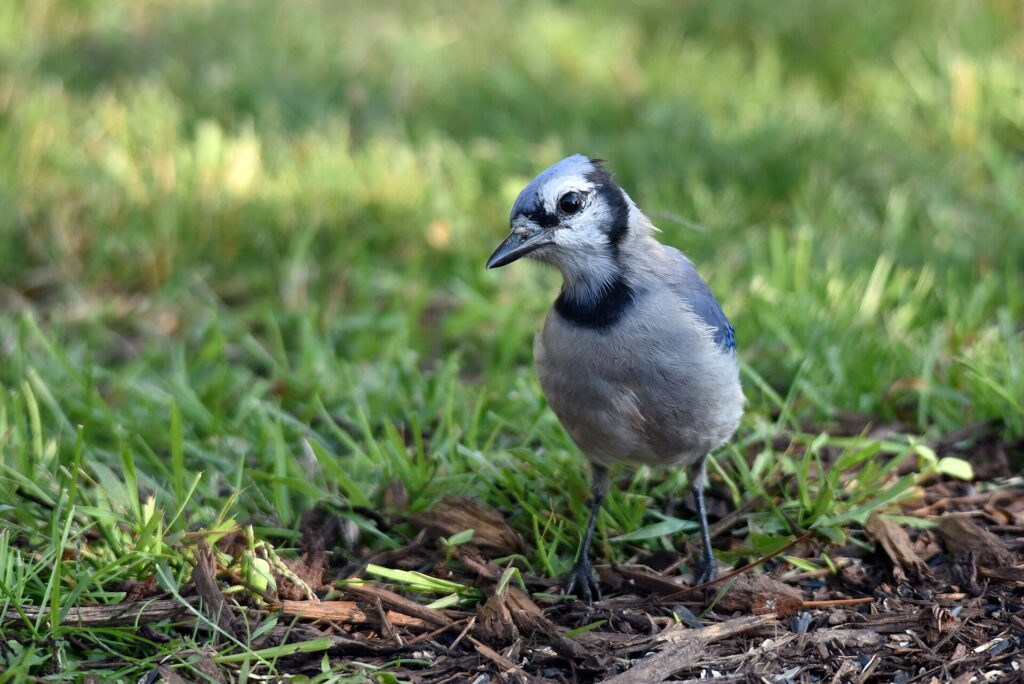
When people search for blue jay meaning, they usually want to know what American folklore says about the bird, and whether seeing one is a sign. The honest answer: the blue jay has a long and mixed reputation in American storytelling, from a Southern folk belief that jays visit the devil every Friday to Mark Twain’s famous joke that a jay is as clever as a person. Those beliefs are folklore, and there is no scientific evidence that birds carry signs or messages. What is real is a loud, smart, family-minded bird whose habits explain almost every story told about it. Below we cover the beliefs as cultural history, the biology behind each one, and a chart we built from federal survey data showing where blue jays are declining and where they are holding on.
The short version
- The folklore: In Southern folk belief, the blue jay was a bird with a bargain with the devil, carrying sticks or grains of sand to him on Fridays. Mark Twain and Joel Chandler Harris made jays a byword for brashness and smarts.
- Native stories: In Chinookan stories from the lower Columbia River, Blue Jay is a trickster who even travels to the land of the dead.
- The biology: Blue jays are noisy, smart and loyal to their families. They often mate for life, mimic hawks, and bury thousands of acorns.
- The trend: On U.S. Breeding Bird Survey routes, blue jays are down about 35% since 1966, with the steepest drops in the South and Northeast. A few states, led by West Virginia, show increases.
Where blue jays are declining, state by state
Part of what makes the blue jay feel familiar is that it’s common in towns and suburbs, especially where there are oaks or bird feeders, according to the Cornell Lab of Ornithology. But “common” is not the same as “steady.” We pulled the Blue Jay rows from the U.S. Geological Survey’s newest North American Breeding Bird Survey results, which cover 1966 to 2025, and charted the yearly trend for every state with usable data.
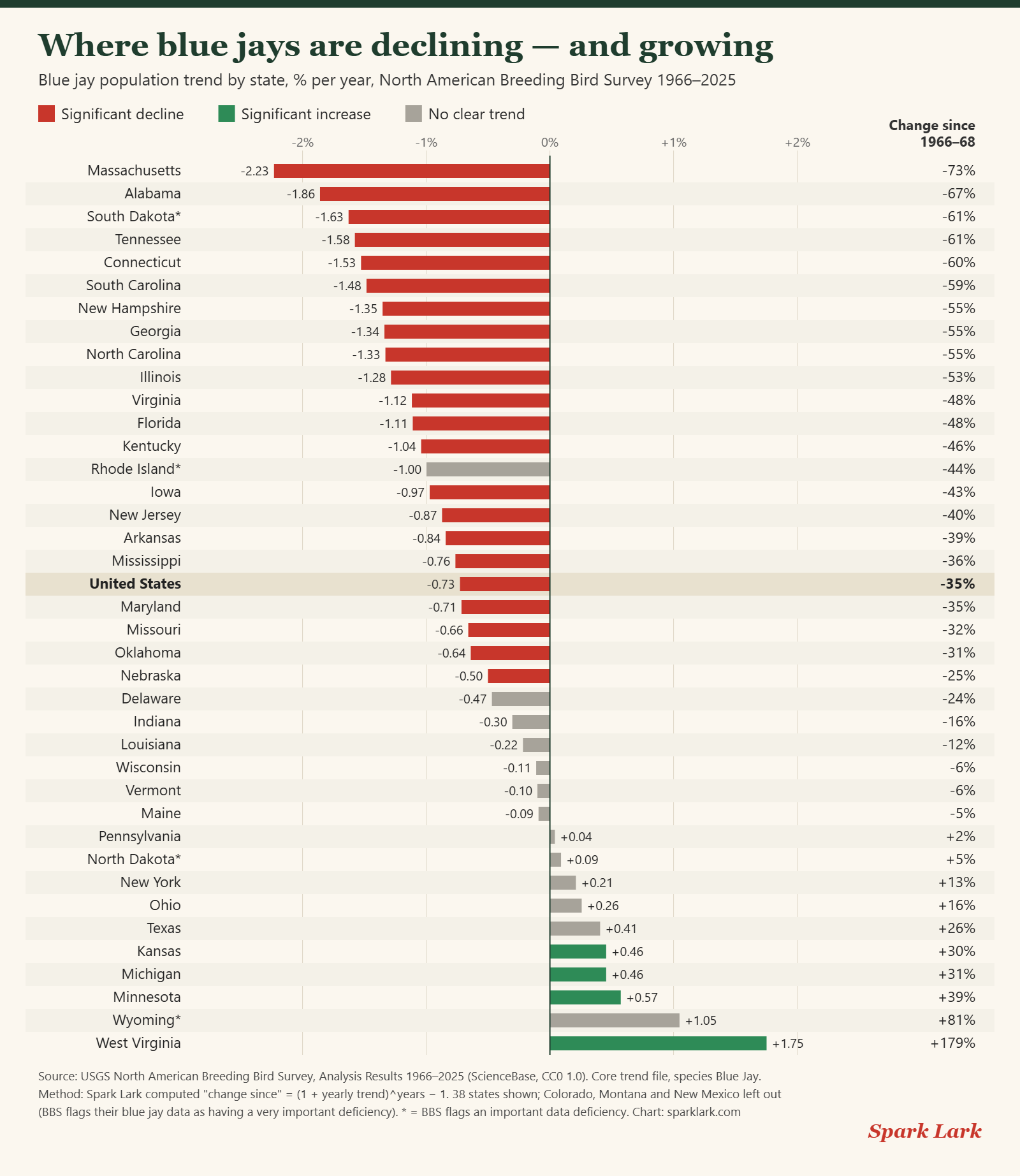
Of the 38 states shown, 21 have a statistically significant decline, 4 have a significant increase, and 13 show no clear trend either way. Across the U.S. as a whole, the survey’s trend is −0.73% a year, which works out to about 35% fewer blue jays on survey routes than in 1966. Here are the biggest movers, plus a few states for comparison:
| State | Trend per year | Change since 1966* | Birds per route (2025 model) |
|---|---|---|---|
| Massachusetts | −2.2% | −73% | 13.6 |
| Alabama | −1.9% | −67% | 24.0 |
| Tennessee | −1.6% | −61% | 14.7 |
| Connecticut | −1.5% | −60% | 14.9 |
| South Carolina | −1.5% | −59% | 23.3 |
| Georgia | −1.3% | −55% | 27.9 |
| Florida | −1.1% | −48% | 15.8 |
| United States | −0.7% | −35% | 9.2 |
| New York | +0.2% | no clear trend | 12.0 |
| Michigan | +0.5% | +31% | 12.3 |
| Minnesota | +0.6% | +39% | 7.7 |
| West Virginia | +1.8% | +179% | 11.2 |
Source and method: USGS North American Breeding Bird Survey, Analysis Results 1966–2025 (ScienceBase, CC0 1.0), core trend file, species Blue Jay. *Spark Lark computed “change since” as (1 + yearly trend) raised to the number of survey years, minus 1, starting from each state’s first survey year (1966 or 1967 for the states above). New York’s trend is not statistically different from zero. Colorado, Montana and New Mexico are left out of the chart because the survey flags their blue jay data as having a very important deficiency. A trend on survey routes is an estimate, not a head count.
Even after those losses, blue jays are far from rare. The Cornell Lab rates the species as low conservation concern, with a global breeding population estimated by Partners in Flight at 17 million. Georgia and Alabama, two of the states with steep declines, still show some of the highest blue jay numbers per survey route. For the bigger picture across many species, see our backyard bird declines by state.
The Friday folklore: blue jays and the devil
The best-known blue jay belief in American folklore comes from the South. In a 1990 episode of her radio program For the Birds, birder and writer Laura Erickson described a plantation-era belief among enslaved people that the jaybird was the “bird of Satan.” According to that lore, you could not see a blue jay on a Friday, because jays spent the day carrying sticks, and reports on what people had been doing, down to the devil. On Saturday they came back, by her account “unusually gay and noisy” to be free of him for another week.
A Virginia mountain version gives the bargain a backstory. In “A Legend of the Blue Jay,” a short story by Ruth Anna Fisher published in the 1920 school reader The Upward Path, children tell how the devil offered the jay a golden ear of corn, then a red one, then a blue one. The jay took the blue ear in exchange for his soul, and now, as the story puts it, he “must carry one grain of sand to the devil” every Friday. The story is reprinted in The Envious Lobster, an online anthology hosted on a UNC Greensboro libraries site.
The real biology: Blue jays don’t disappear on Fridays, but they can go quiet. The Cornell Lab notes that resident jays usually cross open areas one at a time, often silently, and are mostly noticed by their noisy calls. The sticks part of the story has a real counterpart, too: during nesting season both members of a pair gather twigs, and Cornell says they usually take them from live trees and often struggle to break them off. And “one grain at a time” is a fair description of a jay’s autumn: Cornell reports that six radio-tagged blue jays each stored 3,000 to 5,000 acorns in one fall.
“Sassy as a jay-bird”: Uncle Remus and Mark Twain
By the late 1800s the blue jay had become shorthand for brashness. In Joel Chandler Harris’s 1880 book Uncle Remus, His Songs and His Sayings, Brer Rabbit goes down the road “sassy ez a jay-bird.”
The same year, Mark Twain published A Tramp Abroad, which includes “Jim Baker’s Blue-Jay Yarn.” In it, a character named Jim Baker claims he can understand what jays say, and tells of a jay that tries to fill a knothole in a cabin roof with acorns, not knowing the hole opens into an empty room. When the other jays work out what happened, they laugh at him. Baker’s verdict: “There’s more TO a bluejay than any other creature.” He also insists that “a jay is everything that a man is.”
The real biology: Twain was closer to the truth than he probably knew. The Cornell Lab says blue jays are known for their intelligence and complex social systems with tight family bonds, and that captive jays used strips of newspaper to rake in food pellets. Twain’s acorn-hoarding jay is real behavior: a blue jay can carry several acorns at once in a throat pouch, and Cornell credits the species’ acorn burying with helping spread oak trees after the last glacial period. As for “sassy,” blue jays do have a bossy reputation, but Cornell says they are far less aggressive than many other species. In one Florida study, red-headed woodpeckers, common grackles and gray squirrels strongly dominated blue jays at feeders.
Blue Jay the trickster in Chinookan stories
Far from the South, Chinookan peoples of the lower Columbia River told many stories about a character named Blue Jay. Anthropologist Franz Boas recorded a set of them in Chinook Texts (1894), where the index page at Sacred Texts describes Blue Jay as “a rather dim but heroic figure.” World History Encyclopedia’s summary of the tales describes him as a trickster who often torments his patient older sister, Ioi. In one story, “Blue Jay Finds a Wife,” he carries a dead woman to the land of the dead, where supernatural people can bring the dead back to life.
The real biology: The stories don’t name a species, and the jay most people in the Pacific Northwest see is not the blue jay of the East. The Cornell Lab describes the Steller’s jay, a close relative, as a large, dark jay of evergreen forests in the mountainous West. Both are crested, loud and clever, which may explain why jays so often end up as tricksters.
Folklore vs. biology at a glance
| What the story says | Where it comes from | What the biology says |
|---|---|---|
| You can’t see a blue jay on Friday | Southern folk belief (Erickson) | Jays often fly silently across open areas; they’re noticed mainly by their calls |
| Jays carry sticks to the devil | Southern folk belief (Erickson) | Pairs gather nest twigs, usually snapped off live trees |
| A grain of sand each Friday | Virginia mountain legend (Fisher, 1920) | A jay can cache thousands of acorns in one fall, a few at a time |
| “Sassy as a jay-bird” | Harris, 1880 | Bold and noisy, but less aggressive than many feeder birds |
| A jay is as smart as a man | Twain, 1880 | Known for intelligence; captive jays used paper strips as tools |
| Blue Jay the trickster | Chinookan stories (Boas, 1894) | Blue jays mimic hawk calls, sometimes when approaching feeders |
| Blue jays are nest robbers | Common reputation | Only 6 of 530 jay stomachs held egg or nestling traces |
Biology column: Cornell Lab of Ornithology, All About Birds, Blue Jay overview and life history pages.
What about the spiritual meaning of a blue jay?
Many modern “spirit animal” websites assign the blue jay meanings such as communication, boldness or loyalty. We did not find those meanings in the older folklore sources we read for this article; they appear to be modern interpretations rather than recorded tradition. If those ideas speak to you, they are yours to keep. Just know that they are beliefs, not something science can confirm.
Some people also wonder whether a blue jay that keeps showing up is a sign from someone they have lost. That is a deeply human feeling, and many people find comfort in it. There is no scientific evidence that birds carry messages, but there are ordinary reasons a jay might keep coming back: many blue jays stay in the same area all year, they store food to eat later, and they are drawn to yards with oaks or feeders. Blue jays also form strong pair bonds of their own, which we cover in what happens when a blue jay loses its mate.
Blue jay facts that explain the reputation
- They aren’t really blue. The pigment in blue jay feathers is melanin, which is brown. The blue comes from light scattering off modified cells in the feather barbs, according to the Cornell Lab.
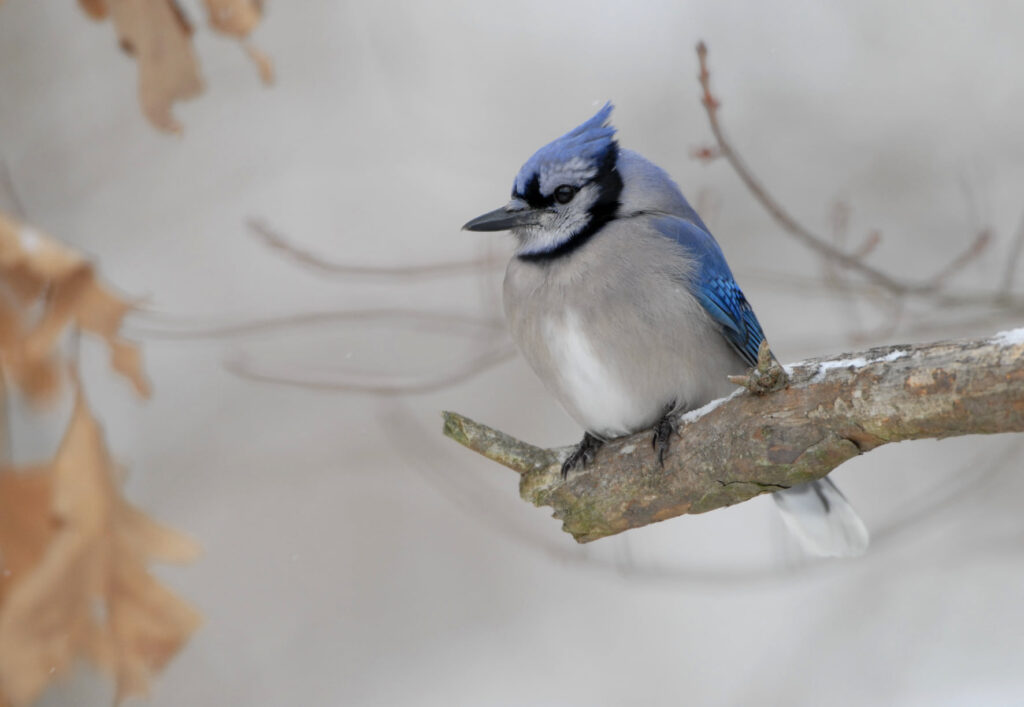
- They talk with their crest. A lowered crest means a calm jay feeding with family or tending young; a raised crest means rising aggression. When a blue jay squawks, Cornell says the crest is almost always up.
- They imitate hawks. Blue jays often mimic red-shouldered and red-tailed hawks. Cornell says the calls may warn other jays, or trick other birds into thinking a hawk is near.
- They’re devoted partners. Blue jays often mate for life. Only the female incubates, and her mate brings all her food while she sits on the eggs.
- They can live a long time. The oldest known wild, banded blue jay was at least 26 years, 11 months old.
- Their migration is still a mystery. Some blue jays migrate and some don’t, and Cornell says no one has worked out why. The share that migrates is probably under 20%.
How to bring blue jays to your yard
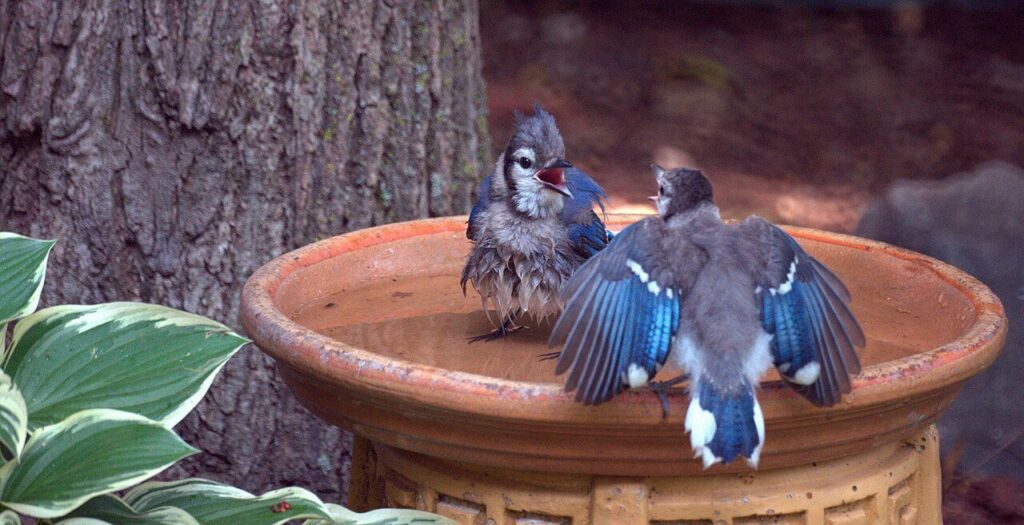
If you’d like to see more blue jays, the Cornell Lab’s advice is simple: they prefer tray feeders or hopper feeders on a post rather than hanging feeders, and they go for peanuts, sunflower seeds and suet. They also drink from birdbaths. Planting oak trees helps too, since acorns are a staple. Our guides to platform bird feeders, hopper bird feeders and bird seed cover the setups jays use. Not sure whether the blue bird at your feeder is a jay? Our free backyard bird ID chart by color can help.
Frequently asked questions
Is it good luck or bad luck to see a blue jay?
Folklore has gone both ways. Southern folk belief tied the jay to the devil, while later writers treated it as a clever, likable rascal. Neither is a real omen; seeing a blue jay mostly means there are oaks, cover or a feeder nearby.
Are blue jays mean to other birds?
They are loud and sometimes chase other birds off a feeder, but the Cornell Lab says they are far less aggressive than many species, and most birds come back quickly once a jay starts eating. They do sometimes take eggs or nestlings, but in one study only 6 of 530 stomachs showed any trace of them.
Why does a blue jay sound like a hawk?
Blue jays are excellent mimics and often copy red-shouldered and red-tailed hawks. If you hear a “hawk” at the feeder and see a jay arrive, that’s likely what happened.
Are blue jays declining?
Yes, gradually. U.S. Breeding Bird Survey routes show about 35% fewer blue jays than in 1966, with the steepest drops in the Southeast and southern New England. The species is still common and rated low conservation concern.
Bottom line
The blue jay’s meaning depends on who’s telling the story. In Southern folk belief it ran errands for the devil on Fridays; to Mark Twain it was as smart and as human as any person; in Chinookan tales it was a trickster bold enough to visit the land of the dead. The bird behind those stories is a loud, clever, loyal one that helps spread oaks one buried acorn at a time, and one that has quietly grown scarcer across much of its range. For more on bird beliefs and the science behind them, read what it means when you see a cardinal and what a white pigeon symbolizes.