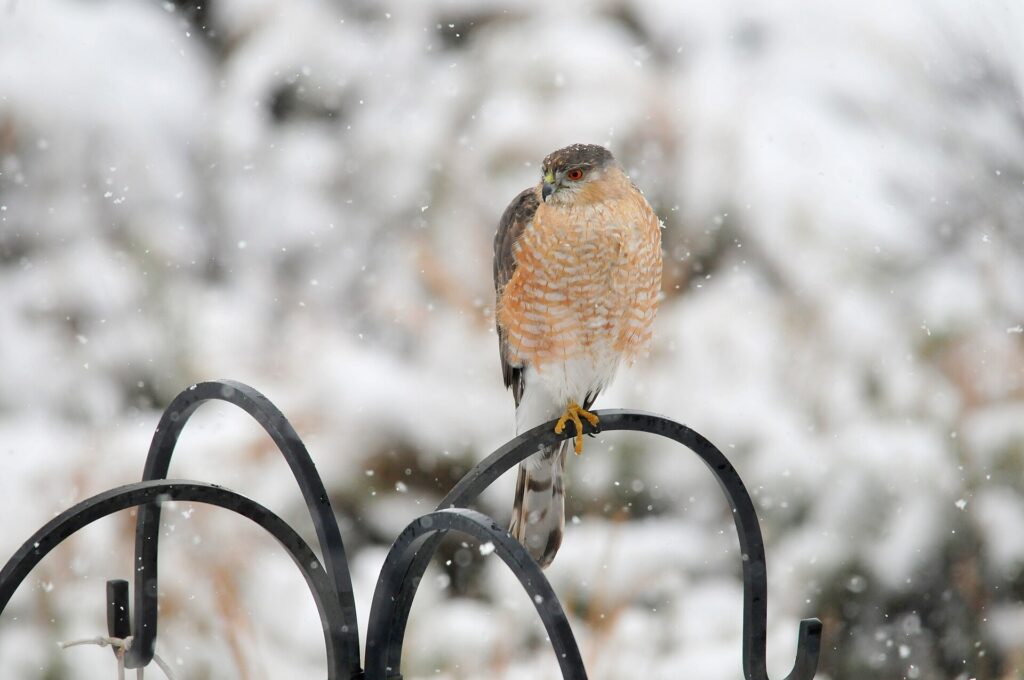
If a hawk is hunting at your bird feeder, it is almost always one of two birds: a Cooper’s hawk or a sharp-shinned hawk. Penn State Extension names these two as the hawks that occasionally hunt birds at feeders, and the two look a lot alike. The quickest clues are the tail tip (rounded on a Cooper’s, square on a sharp-shinned), the size of the head, and the thickness of the legs. Our field-mark chart below puts them side by side. If the hawk keeps coming back, the usual advice from wildlife agencies is simple: take your feeders down for one to two weeks so the small birds scatter and the hawk moves on.
Cooper’s or sharp-shinned? Our field-mark chart
We drew this chart to answer the one question everyone asks when a hawk lands on the feeder pole. The top half shows body length to scale, with a blue jay and an American crow for comparison. The bottom half lists the field marks that separate the two species. Tap or click the chart to open the full-size version.
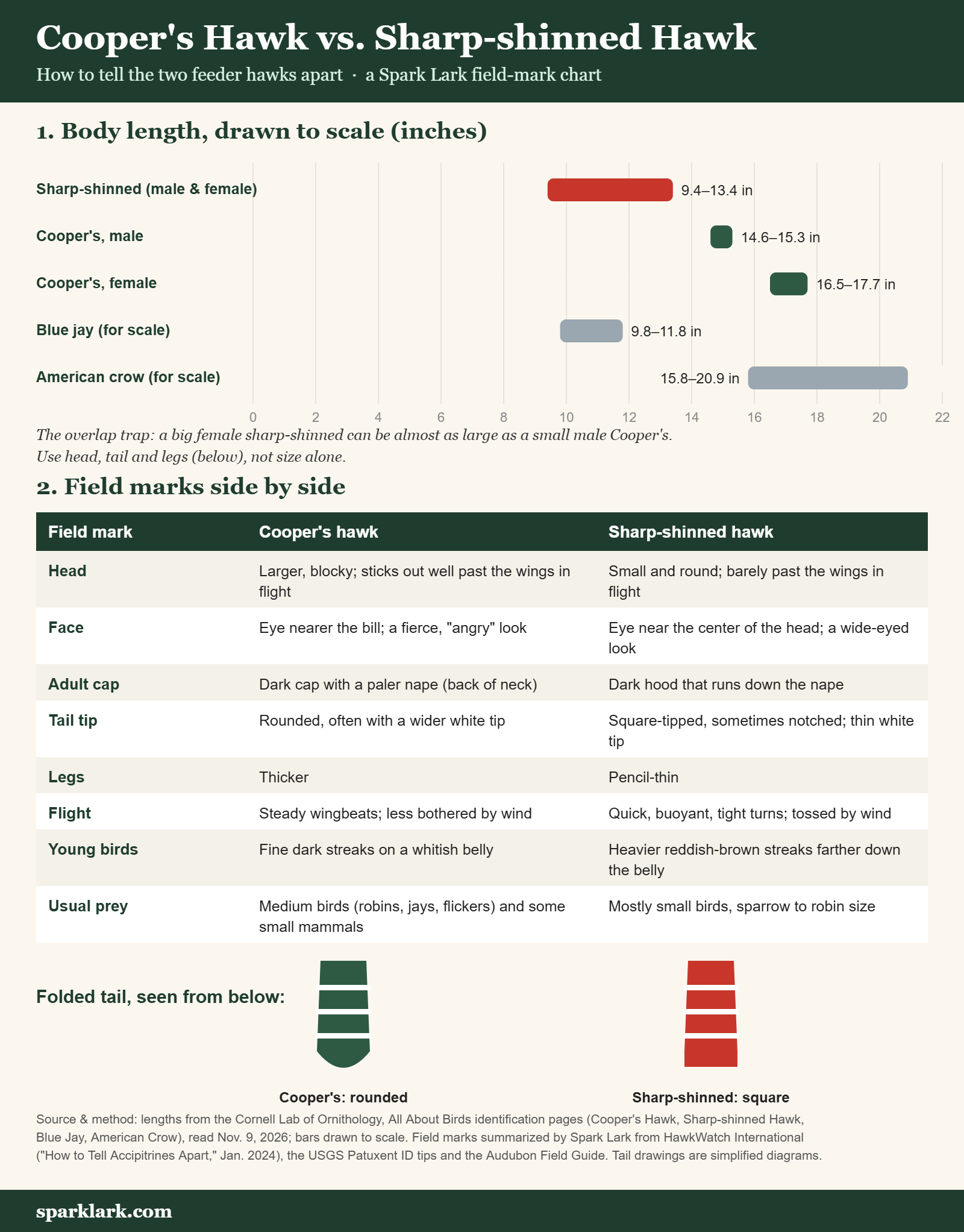
Source and method: body lengths are from the Cornell Lab of Ornithology’s All About Birds identification pages for Cooper’s hawk (male 14.6–15.3 in, female 16.5–17.7 in), sharp-shinned hawk (9.4–13.4 in, both sexes), blue jay (9.8–11.8 in) and American crow (15.8–20.9 in), read Nov. 9, 2026, and drawn to scale. Field marks are our summary of HawkWatch International’s “How to Tell Accipitrines Apart” (Sammy Riccio, Jan. 2024), the USGS Patuxent Wildlife Research Center ID tips, and the Audubon Field Guide. The tail drawings are simplified diagrams, not tracings of real birds.
How to tell a Cooper’s hawk from a sharp-shinned hawk
Both birds are accipiters: woodland hawks with rounded wings and long tails that hunt other birds. Adults of both species are blue-gray above and pale reddish below, and young birds of both are brown above and streaked below, according to the Audubon Field Guide. So color alone will not settle it. Work through these clues instead.
1. Look at the tail tip
This is the best single clue on a perched bird. A Cooper’s hawk’s tail is rounded at the end because the outer feathers are shorter than the middle ones. A sharp-shinned hawk’s tail usually looks squared off when folded and may show a small notch. The USGS Patuxent ID notes add that young sharp-shinned hawks have a thinner white band at the tail tip.
2. Check the head and face
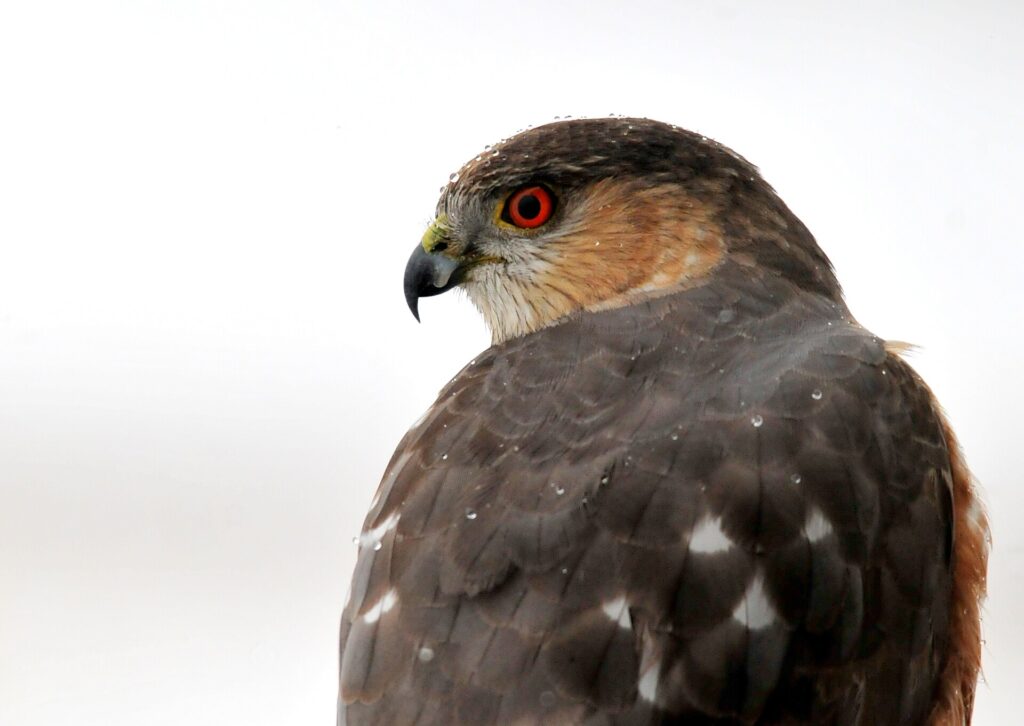
A Cooper’s hawk has a larger, blockier head, and in flight it sticks out well past the front of the wings. A sharp-shinned hawk’s head is small and round and barely shows past the wings in flight. HawkWatch International points out that the sharp-shinned hawk’s eye sits nearer the center of its head, which gives it a “wide-eyed” look, while a Cooper’s eye sits closer to the bill and the bird looks fierce. On adults, a Cooper’s hawk wears a dark cap with a paler back of the neck; a sharp-shinned hawk’s dark hood runs down the nape.
3. Notice the legs
Audubon describes the sharp-shinned hawk’s legs as pencil-thin; a Cooper’s hawk’s legs are thicker. HawkWatch warns that this clue is hard to judge unless you can compare birds, so use it to back up the tail and head rather than on its own.
4. Compare the size, carefully
Cornell’s All About Birds calls the Cooper’s hawk roughly crow-sized, though males can be much smaller. A male sharp-shinned hawk is about the size of an American kestrel, slightly larger than a jay. The catch: female hawks are bigger than males, and Cornell notes that female sharp-shinned hawks approach the size of a male Cooper’s hawk. That overlap is why size alone fools people. A tiny, jay-sized hawk is a sharp-shinned. A crow-sized one is a Cooper’s. Anything in between needs the tail and head.
5. Young birds: read the streaks
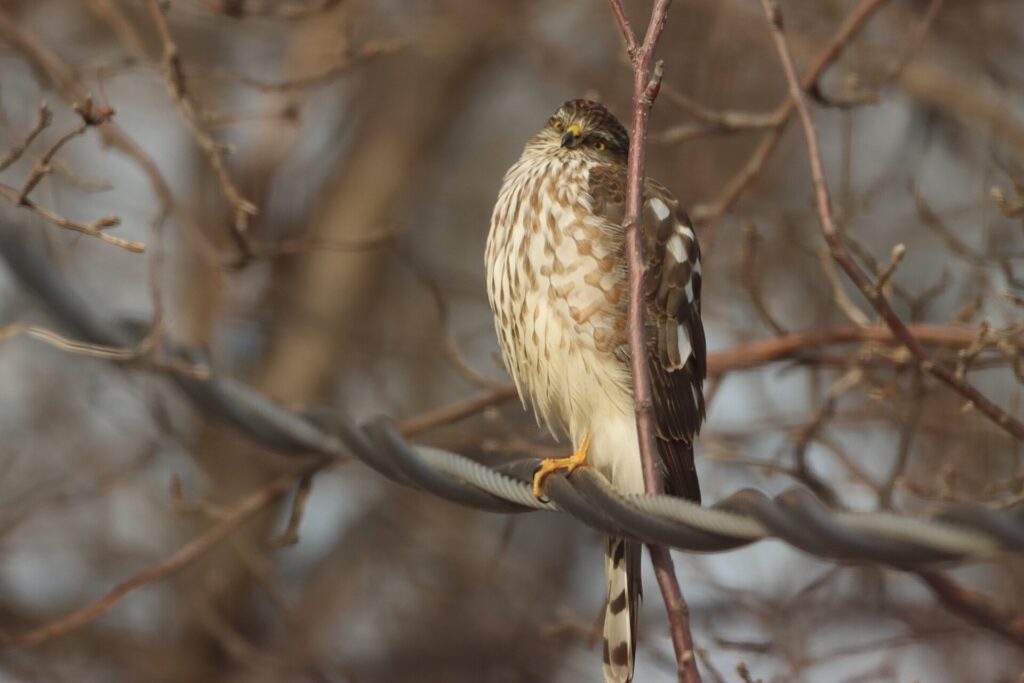
Brown, streaky young hawks are the hardest. HawkWatch describes a young Cooper’s hawk as whitish below with narrow, dark brown streaks shaped like teardrops. A young sharp-shinned hawk is buffier below, with reddish-brown streaks that look heavier and messier and, per the USGS notes, run farther down the belly.
| What you noticed | Points to |
|---|---|
| Rounded tail tip | Cooper’s hawk |
| Square or notched tail tip | Sharp-shinned hawk |
| Big, blocky head; fierce look | Cooper’s hawk |
| Small, round head; wide-eyed look | Sharp-shinned hawk |
| Dark cap, paler back of the neck (adult) | Cooper’s hawk |
| Pencil-thin legs | Sharp-shinned hawk |
| About jay-sized | Sharp-shinned hawk |
| About crow-sized | Cooper’s hawk (likely a female) |
| Steady flight, little bothered by wind | Cooper’s hawk |
| Quick, buoyant flight, tossed by wind | Sharp-shinned hawk |
A good pair of binoculars makes the tail tip and head shape much easier to see from the kitchen window. Our guide to the best budget binoculars for birding covers solid options. For the rest of your feeder visitors, our free backyard bird ID chart by color helps.
Why hawks come to bird feeders
Hawks are not after the seed. A feeder gathers dozens of small birds in one open spot, and to a bird-eating hawk that is a reliable place to find a meal. Penn State Extension and the Cornell Lab both put it this way: feeders concentrate small birds, and the hawks follow.
The two species tend to take different prey. The Audubon Field Guide says sharp-shinned hawks eat mostly small birds, from sparrow size up to robin size, usually hunting from a perch inside foliage. Cooper’s hawks take mainly medium-size birds such as robins, jays and flickers, plus small mammals like chipmunks and squirrels, and they hunt by stealth from cover before a fast dash.
Seeing one is more common than it used to be. In a 2016 National Wildlife article, Cornell’s Project FeederWatch reported Cooper’s hawks at 6.4% of participating feeders in 1989 and 21.9% by 2014, and project leader Emma Greig described a “significant increase in the number of Cooper’s hawks visiting feeders.” The same article quoted Audubon’s Christmas Bird Count director saying counters are about three times as likely to see a Cooper’s hawk as in 1960. Audubon notes that Cooper’s hawks are increasingly found in suburbs and cities with tall trees for nesting. If you count birds for Project FeederWatch or the Christmas Bird Count, you may well spot one on count day. Curious about the calls hawks make? See why do hawks screech?
Is a hawk bad for my backyard birds?
Watching a hawk grab a chickadee is hard, but it is not a problem for bird populations. Penn State Extension says hawks have little, if any, negative effect on bird numbers overall, because there are far fewer hawks than songbirds and their hunting success is limited. In the same National Wildlife piece, Greig said there was no evidence hawks had caused a decline in any feeder species, and that sparrows, juncos and mourning doves were doing well. Penn State sums it up: “Hawks are a natural part of the ecosystem and signify a healthy environment.”
Hawks have also had their own troubles. Audubon says both species declined in the mid-1900s, possibly because of DDT and other pesticides, and the sharp-shinned hawk’s count of eastern migrants has shown significant declines since the early 1980s.
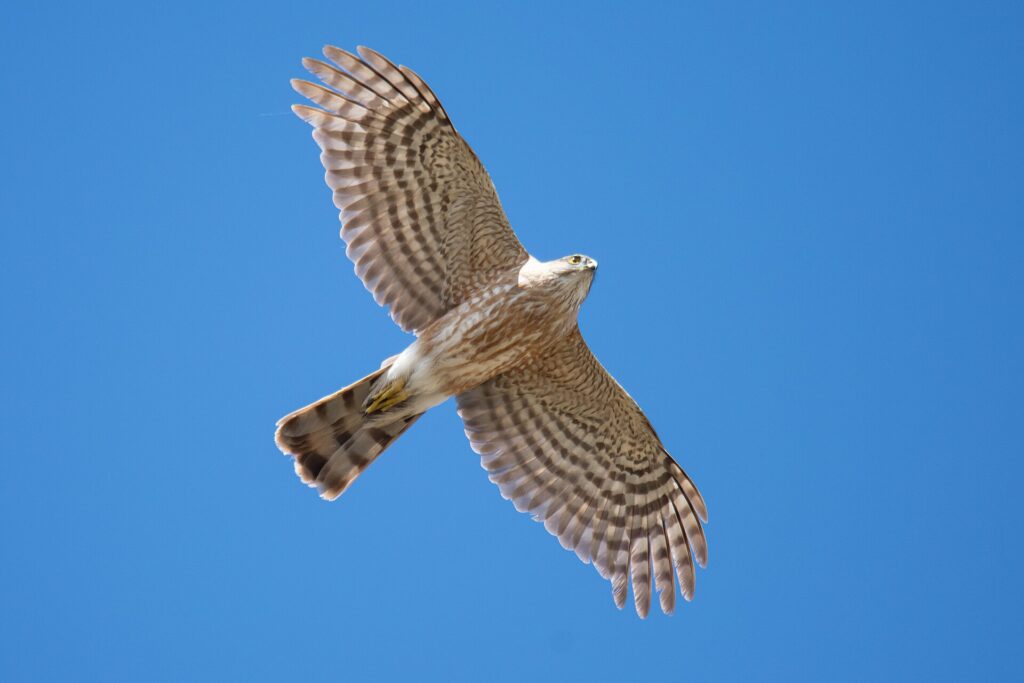
What to do when a hawk keeps hunting at your feeder
A hawk that drops in once and leaves needs no action. If it returns day after day, here is what the Cornell Lab and state wildlife agencies recommend.
- Take the feeders down for one to two weeks. The Cornell Lab suggests a pause of a few days until the small birds disperse, then putting feeders back after a week or two; Virginia’s Department of Wildlife Resources says at least one to two weeks, and Michigan’s DNR says at least two weeks. Songbirds may return quickly, and the hawk may have found a new hunting spot by then.
- Add thick cover nearby. Penn State recommends dense plantings so small birds have somewhere to dive when a hawk appears, and Virginia suggests native plants that give songbirds food and shelter so they spread out. Our bird-friendly garden guide has ideas.
- Clean up spilled seed. Michigan’s DNR notes that spilled seed draws rodents, which in turn draw raptors. While you’re at it, see how to clean a bird feeder.
- Watch small pets. Michigan’s DNR advises supervising small pets outdoors, especially at dawn and dusk. For more on the risk to people and pets, read are hawks dangerous to humans?
- Don’t expect gadgets to fix it. Michigan’s DNR says reflective tape, spinning objects and motion lights may help but are often temporary.
What you cannot do is harm, trap or kill the hawk. Hawks are protected under the federal Migratory Bird Treaty Act; Virginia’s wildlife agency puts it plainly that people cannot destroy or harm them, and Michigan’s DNR says lethal removal requires a federal depredation permit from the U.S. Fish and Wildlife Service. During migration, the Cornell Lab adds, a passing hawk may visit briefly and there is little you can do but wait.
If your feeder went quiet and you are not sure a hawk is the reason, our checklist on why birds aren’t coming to your feeder covers the other common causes. And once the hawk has moved on, a well-stocked winter feeder will bring the regulars back; see our picks for the best bird feeders for winter.
FAQ
Can a sharp-shinned hawk be as big as a Cooper’s hawk?
Nearly. Female sharp-shinned hawks are about a third larger than males, and Cornell says they approach the size of a male Cooper’s hawk. When the size is in that middle range, go by the tail tip and head shape.
Will my birds come back after a hawk attack?
Usually. The Cornell Lab says songbirds and doves may return quickly once feeders go back up after a break, while the hawk may have moved on to other hunting grounds.
Can I have the hawk relocated?
Not on your own. Hawks are federally protected, and Michigan’s DNR, for example, says it does not live-capture and release hawks except for permitted research. Taking feeders down for a couple of weeks is the approach agencies recommend.
Bottom line
A hawk at your bird feeder is almost certainly a Cooper’s hawk or a sharp-shinned hawk. Check the tail tip first (rounded means Cooper’s, square means sharp-shinned), then the head and legs, and use size only as a rough guide because big female sharp-shinned hawks overlap small male Cooper’s. Hawks at feeders are a natural part of a healthy yard and have little effect on bird populations. If one won’t leave, take your feeders down for one to two weeks, add thick cover, and never try to harm the hawk: it is protected by federal law.