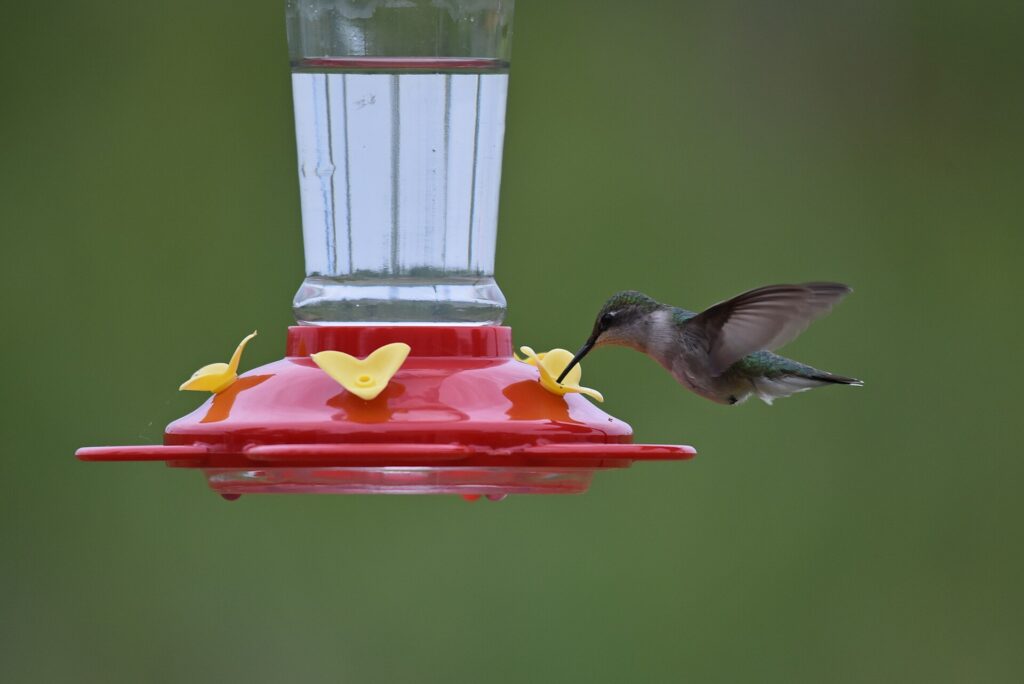
The standard sugar water for hummingbirds is 1 part refined white sugar to 4 parts water, for example 1/4 cup of sugar in 1 cup of water. Audubon, the Cornell Lab of Ornithology and the Smithsonian’s National Zoo all give that same ratio, and none of them add anything else: no red dye, no honey. The trickier question is how long it lasts. Cornell’s All About Birds says sugar water “should never be left out for more than two or three days,” and it should be changed daily in very hot weather. Below you’ll find a free printable card with the recipe and a change-by-temperature schedule, what five sources say side by side, and how to keep a feeder going in winter.
Free printable: hummingbird sugar water card
We put the recipe, the “never add” list, a nectar-change schedule by temperature, cleaning steps and winter tips on one page you can tape inside a kitchen cabinet. It’s free, with no signup. Click the card to open the full-size version, then print it.
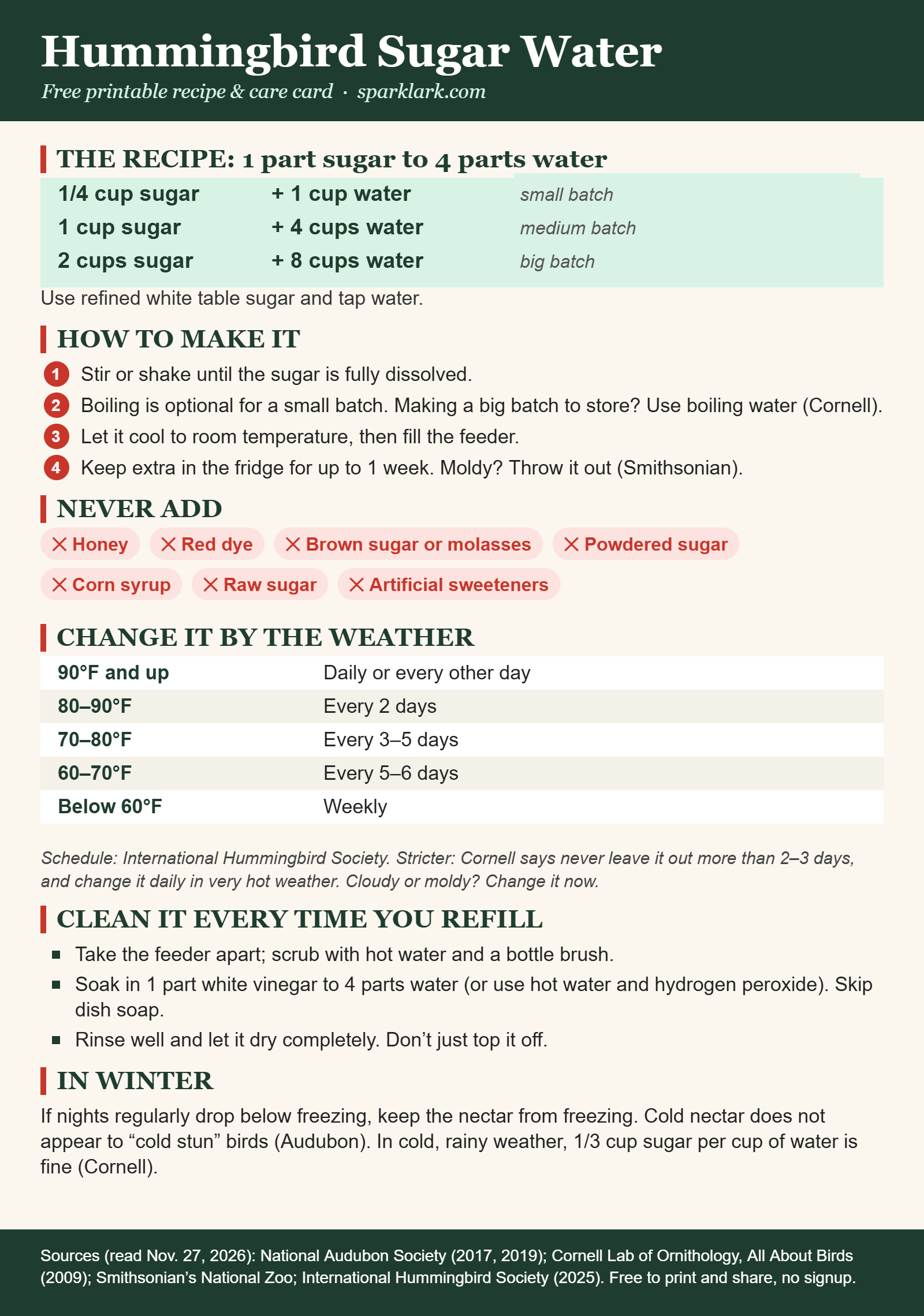
The recipe: 1 part sugar, 4 parts water
The Smithsonian’s National Zoo explains that a “part” can be any measurement, as long as you use the same one for the sugar and the water. So these all make the same nectar:
- 1/4 cup sugar + 1 cup water (Audubon’s single-batch recipe)
- 1/2 cup sugar + 2 cups water
- 1 cup sugar + 4 cups water
- 2 cups sugar + 8 cups water (a big batch to store)
Stir or shake until the sugar is fully dissolved, let it cool to room temperature, and fill the feeder. Regular tap water is fine, according to the Smithsonian. Use plain refined white table sugar; the list of things to leave out is below.
Do you need to boil the water?
This is where the sources split. Audubon’s feeding FAQ says to bring the solution to a boil and let it cool, and its recipe uses boiling water. The Smithsonian’s National Zoo says the water “does not need to be boiled,” as long as the sugar fully dissolves. Cornell lands in the middle: if you mix small amounts every day or two, there’s no need to boil, but if you make a larger batch and refrigerate part of it, “it’s wise” to use boiling water.
So the simple rule is: small batch, boiling is optional; big batch for the fridge, boil it. Either way, never pour warm nectar into the feeder. Let it cool first.
What five sources say, side by side
We read the hummingbird feeding guidance from Audubon (two pages), the Cornell Lab, the Smithsonian’s National Zoo and the International Hummingbird Society, and lined up what each one says. They agree on the ratio. They differ on boiling and on how often to change the nectar.
| Source | Ratio | Boil the water? | Store extra in the fridge? | How often to change it |
|---|---|---|---|---|
| Audubon, “Hummingbird Feeding FAQs” (2017) | 1 part sugar to 4 parts water | Yes, then let it cool | Yes; bring it to room temperature before refilling | Hot weather: every day or every other day. Temperate: every 3 days. Cooler: twice a week |
| Audubon, “How to Make Hummingbird Nectar” (2019) | 1/4 cup sugar to 1 cup water | Uses boiling water | Not stated | Not stated |
| Cornell Lab, All About Birds, “Feeding Hummingbirds” (2009) | 1/4 cup sugar per cup of water; 1/3 cup is fine in cold, rainy or foggy weather | Only needed for larger batches you store | Yes, for larger batches | Never more than 2 to 3 days; daily in very hot weather |
| Smithsonian’s National Zoo, “Hummingbird Nectar Recipe” | 1 part sugar to 4 parts water | No | Up to one week | Every other day recommended; at least twice a week in summer, once a week in spring and fall |
| International Hummingbird Society (2025) | Not stated | Not stated | Not stated | By temperature: 90°F and up, daily or every other day; below 60°F, weekly (full schedule below) |
Source: each organization’s own web page, read Nov. 27, 2026. “Not stated” means that page doesn’t address it.
How long does hummingbird sugar water last?
In the feeder, it depends mostly on heat. Sugar water grows bacteria and mold, and the sugar ferments, Cornell explains, and the International Hummingbird Society says it “can ferment quickly, especially in warm weather.” The Society’s schedule:
- 90°F and up: daily or every other day
- 80–90°F: every 2 days
- 70–80°F: every 3–5 days
- 60–70°F: every 5–6 days
- Below 60°F: weekly, however cold it gets
Cornell’s advice is stricter: no more than two or three days at any temperature. When sources disagree, the shorter interval is the cautious choice. Whatever schedule you follow, change the nectar right away if it looks cloudy or has debris floating in it (Hummingbird Society), or if you see mold, a sick bird has used the feeder, or insects have gotten in (Audubon).
A few things make it spoil faster. Cornell says direct sun “causes the sugar solution to spoil rapidly,” and bottle feeders tend to leak in the sun as warming air pushes the nectar out, so hang feeders in the shade. The Smithsonian also suggests shade, away from windows and busy areas, near trees where hummingbirds can perch.
In the fridge, extra sugar water keeps for up to one week, according to the Smithsonian; throw it out if you see mold. Audubon adds one step: let refrigerated nectar come back to room temperature before you fill the feeder.
And keep changing it even when nobody’s drinking. Audubon says to follow the cleaning schedule even if the nectar goes untouched, and to discard any leftover nectar when you take the feeder down to clean.
What never to put in hummingbird food
- Honey. Diluted honey lets bacteria and fungus thrive (Cornell); Audubon says it can promote dangerous fungal growth.
- Red food coloring. Not necessary and possibly harmful, per Audubon, Cornell and the Smithsonian. Flower nectar is clear; it’s the flowers that are colorful, and feeders already have red parts.
- Brown sugar or molasses. Audubon says other sweeteners have additional ingredients that can harm hummingbirds.
- Powdered sugar. The Smithsonian notes it often contains cornstarch.
- Corn syrup or raw, unprocessed sugar. On the Smithsonian’s “never” list.
- Artificial sweeteners. Audubon: never use them.
You don’t need store-bought nectar either. Audubon calls the 1:4 homemade solution the best and least expensive option, and Cornell says there’s no need for red-colored commercial mixes.
How to clean a hummingbird feeder
Clean the feeder every time you change the nectar. The International Hummingbird Society says not to “top off” a feeder without cleaning it. Its steps, plus Audubon’s:
- Take the feeder completely apart: reservoir, ports, perches.
- Rinse with hot water and scrub every surface with a bottle brush. Pipe cleaners or small port brushes help with the feeding holes (Hummingbird Society).
- For a deeper clean, soak the parts in 1 part white vinegar to 4 parts water for an hour (Hummingbird Society). Audubon says hot tap water with hydrogen peroxide also works, or a weak vinegar solution.
- Skip dish soap, which Audubon says can leave a harmful residue.
- Rinse well and let every part air-dry before refilling.
An easy-to-clean feeder makes all of this faster. Cornell’s checklist: it should come apart easily, and the fill hole should be wide enough for a bottlebrush. We compare models in our best hummingbird feeders guide. One more Cornell tip: yellow bee guards can actually attract bees. If insects are a problem, see our guide to keeping bees and wasps off hummingbird feeders. For seed feeders, our bird feeder cleaning guide covers the rest.
What size hummingbird feeder should you buy?
Smaller than you might think. Cornell says the best-sized feeders “are those that are emptied every day or two” by the hummingbirds you have. A big bottle that sits half full for a week just gives the nectar time to spoil. If you already own a large feeder, you can fill it only partway.
Cornell also says more feeders beat bigger feeders. Hummingbirds are often very territorial, so four tiny one-port feeders spread around your home will attract and keep more hummingbirds than one large feeder with eight ports. (That territorial streak comes up again in why hummingbirds hover in your face.)
Sugar water for hummingbirds in winter
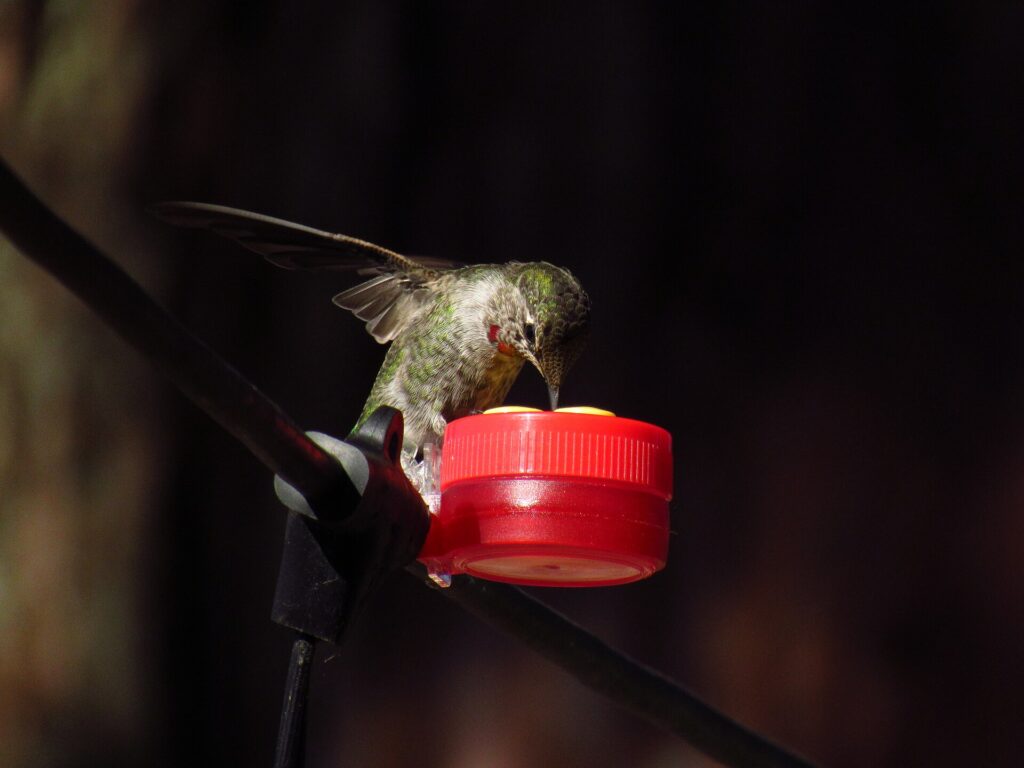
By the Smithsonian’s guidelines, feeder season runs to about early November along the Gulf Coast and ends earlier farther north (see when hummingbirds leave, by state). But Audubon notes that several species regularly spend the winter along the Gulf Coast, in southern Arizona and in south Florida, and that Anna’s hummingbirds live year-round along the Pacific coast from northwestern Baja California to British Columbia. Allen’s hummingbirds are resident in coastal Southern California. If you have hummingbirds all year, Audubon says it’s fine to feed them all year.
Three things to know in cold weather:
- Freezing. If nights regularly drop below freezing, Audubon says you’ll need to keep the nectar from freezing. Where nights dip only slightly below freezing, the nectar may not freeze, because sugar water has a lower freezing point than plain water.
- Cold nectar. Contrary to popular belief, Audubon says drinking cold nectar does not appear to “cold stun” hummingbirds.
- A stronger mix? Cornell says 1/3 cup of sugar per cup of water is fine during cold, rainy or foggy weather, when birds need more energy. Natural nectars vary within about that range.
Late visitors can show up into early winter, too. Audubon and the Smithsonian both say leaving a clean feeder up longer does no harm, and that it won’t keep hummingbirds from migrating: day length tells them when to go. More on timing in when to take down hummingbird feeders.
FAQ
Is a 1:3 or 1:4 ratio better for hummingbirds?
1:4 is the standard from Audubon, Cornell and the Smithsonian. Cornell says 1/3 cup of sugar per cup of water is fine in cold, rainy or foggy weather.
How long can hummingbird nectar sit out?
Cornell says never more than two or three days, and daily in very hot weather. The Hummingbird Society’s schedule runs from daily at 90°F and up to weekly below 60°F.
How long does sugar water last in the fridge?
Up to one week, according to the Smithsonian’s National Zoo. Let it warm to room temperature before filling the feeder (Audubon).
Can I use tap water?
Yes. The Smithsonian says tap water is fine.
Should I keep changing the nectar if no hummingbirds come?
Yes. Audubon says to change the solution and clean the feeder on schedule even if you haven’t seen any hummingbirds. Planting nectar flowers nearby can help them find it; see our hummingbird plants guide.
Bottom line
Sugar water for hummingbirds is 1 part plain white sugar to 4 parts water, with nothing added. Boil it if you’re making a big batch to store, let it cool, and keep extras in the fridge for up to a week. In the feeder, change it every two to three days at most, every day or two when it’s hot, and clean the feeder every time. Print the free card above, hang a small feeder in the shade, and enjoy the visitors. Curious what people have long believed about these birds? Read our hummingbird meaning and folklore piece.