To get rid of grackles, take away what brought them: food they can reach, trees they can sleep in, and places to nest. Put pet food and trash out of reach, switch to feeders grackles can’t use, break up an evening roost with sharp noise for four or more evenings in a row, and remove nests while they’re still being built, before any eggs are laid. Grackles are protected by federal law, so the job is to make your yard less useful to them, not to harm them. Most big flocks are seasonal, and a yard that offers them nothing gets skipped.
The short version
- Food first: bring in pet food, lid the trash, pick up fallen fruit, and stop feeding on the ground.
- Feeders: no cracked corn or cheap mix, no platform trays, and feeders made for small birds. Our step-by-step guide to keeping grackles and blackbirds off feeders covers this part in detail.
- A roost in your trees: sharp, loud noise starting as the birds settle in, at least four evenings in a row. Thinning dense trees helps.
- Nests: remove them while they’re being built. Once there are eggs or chicks, leave the nest alone.
- Don’t bother with: fake owls, shiny tape, or poison. Shooting and trapping are off the table for a backyard problem.
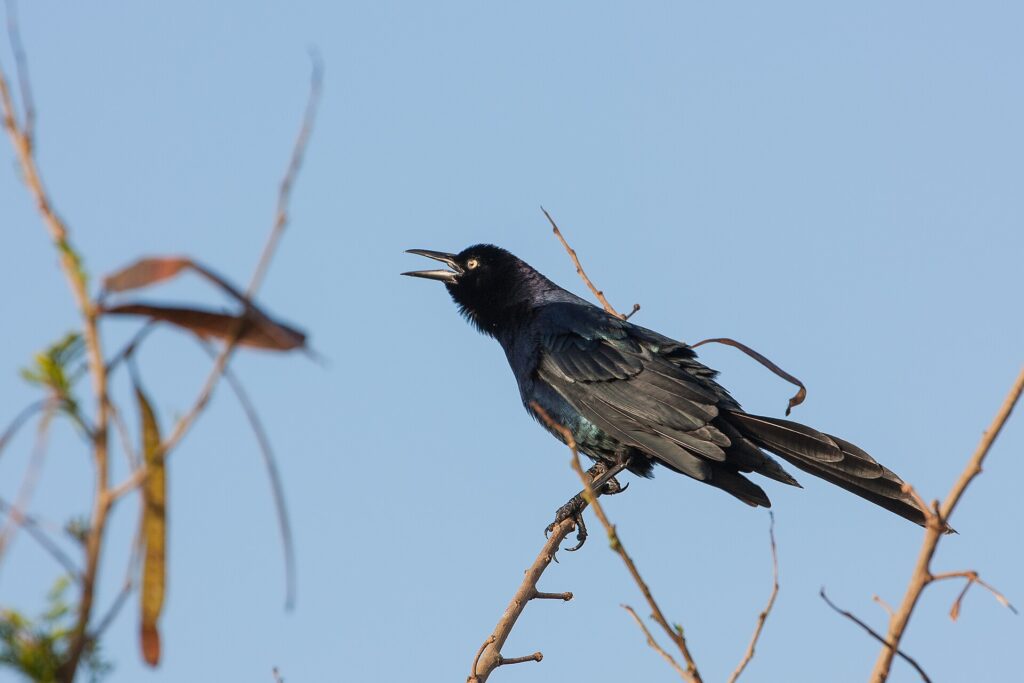
First, which grackle do you have?
Three grackles live in the lower 48 states, and where you live mostly decides which one is in your yard. All three are big, long-tailed blackbirds, and the males are glossy black. Cornell Lab of Ornithology calls the common grackle “large, noisy, and gregarious,” which describes all of them.
| Common grackle | Great-tailed grackle | Boat-tailed grackle | |
|---|---|---|---|
| Where | East and Midwest | Texas, the Southwest and southern Great Plains, and spreading | Atlantic and Gulf coasts; in Florida, often inland too |
| Size | 11 to 13.4 inches | 15 to 18 inches; males nearly twice the size of females | 10.2 to 14.6 inches; larger than a common grackle |
| Where it hangs out | Suburbs, city parks, lawns, fields | Suburbs, parks, lawns, golf courses | City streets and plazas, beaches, marshes |
| Where it nests | High in conifers, often near water; loose colonies | High in trees, or marsh plants and buildings | Marsh grasses about 2 feet up |
If you’re not sure whether you’re looking at grackles, starlings or red-winged blackbirds, our guide to telling grackles, blackbirds and starlings apart sorts it out quickly, and the free printable backyard bird ID chart has them in its black-bird band. The advice below works for all of them, since they often travel together. Cornell notes that common grackles flock with blackbirds, cowbirds and starlings.
Are grackles protected?
Yes. All three grackles are native birds covered by the Migratory Bird Treaty Act, which, as the U.S. Fish and Wildlife Service puts it, prohibits “the take (including killing, capturing, selling, trading, and transport)” of protected birds without authorization.
There is a narrow federal exception. A depredation order (50 CFR 21.150) lets people control blackbirds, cowbirds, crows, magpies and grackles without a permit when the birds are seriously damaging crops or livestock feed, causing a health hazard or property damage, or threatening endangered species. Even then, the rule requires trying nonlethal methods first each year, using nontoxic shot, following state and local law, and filing an annual report with the Fish and Wildlife Service. That’s a tool for farms and damage cases, not for a yard where grackles are loud and eat the birdseed. Everything in this article is nonlethal.
Nests are protected too. The Fish and Wildlife Service says it is illegal to destroy a nest that has eggs or chicks in it, or young birds still dependent on it. More on that in the nesting section below.
Step 1: Take away the food
Grackles eat almost anything. Cornell lists grains, sunflower seeds, acorns, fruit and garbage for the common grackle, plus insects, small fish, frogs and mice. Boat-tailed grackles take food from people, pets and other birds, and often dunk bread, rice or dog food in water before eating it. A yard with easy food is a yard they’ll come back to every day.
- Pet food: feed dogs and cats indoors, or pick up the bowl as soon as they’re done. An outdoor bowl is easy food.
- Trash and compost: use cans with tight lids, and don’t leave bagged trash out overnight. Keep food scraps out of open compost piles.
- Fruit: pick up fallen fruit under trees, and harvest ripe fruit promptly.
- Ground feeding: stop scattering seed on the ground or on low trays. Grackles prefer to feed on the ground, and seed spilled under a feeder counts as ground feeding.
- Feeders: skip cracked corn and cheap mixes; Cornell says grackles eat mostly grains such as corn. Cornell’s Project FeederWatch recommends feeders made for smaller birds, such as tube feeders with short perches, and avoiding platform trays where big birds feed. Caged tube feeders and weight-activated feeders set to close under a heavy bird do the same job; our squirrel-proof bird feeder guide notes which models shut out grackles and starlings. If they’re on the suet, an upside-down suet feeder helps, and the best suet feeders guide covers the options.
For a fuller look at what grackles go after in a yard, see what grackles eat. For the suet and mealworm side of the problem, the same fixes that work on starlings work on grackles: see how to keep starlings off suet and mealworm feeders.
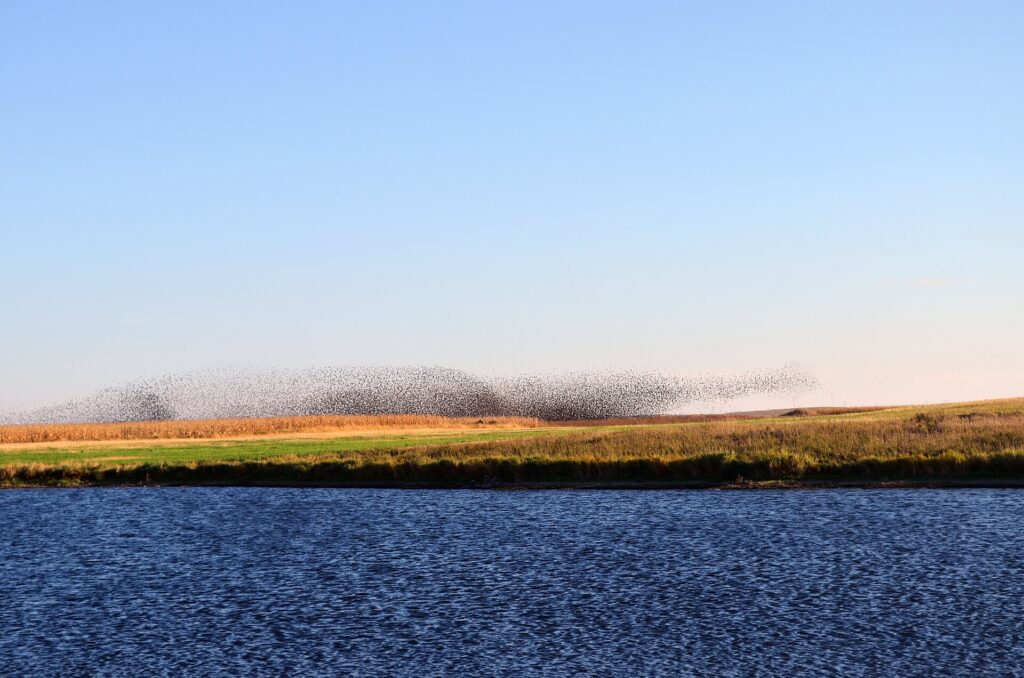
Step 2: Break up a roost in your trees
The noisiest grackle problem isn’t the feeder. It’s the evening roost: dozens or hundreds of birds piling into the same trees at dusk. Cornell describes great-tailed grackle roosts as “raucous flocks” packing neighborhood trees, and says common grackles in winter roost in communal flocks with other blackbirds that can number in the millions.
University of Missouri Extension’s guide to blackbird roosts lays out a method that works for homeowners:
- Start early. Begin two to three hours before dark, or as soon as the birds start settling in.
- Use sharp noise, not steady noise. The guide says “sharp, loud noises are more effective than loud, sustained sounds.” Banging pots or trash can lids, beating a metal tub, or slapping two boards together all count.
- Keep at it. Plan on at least four evenings in a row. An established roost can take up to a week before the birds give up on it.
- Make the trees less attractive. The same guide recommends removing understory shrubs and brush and discouraging interlocking branches between trees. A thinned-out stand gives the flock less cover.
The extension guide also mentions pyrotechnic noisemakers and recorded distress calls. Check your city’s rules on noise and fireworks, and talk to your neighbors, before trying either. A roost that moves one yard over just becomes your neighbor’s problem. For big roosts in town, Missouri’s Department of Conservation recommends a community effort: plan in spring or early summer, get any permits needed, use at least three people, and expect three to five or more evenings in a row.
Why bother? Besides the noise, droppings pile up under a big roost. University of Missouri Extension notes that accumulated droppings can grow the fungus that causes histoplasmosis in people and animals. That’s a good reason to move a roost early rather than wait out a whole season.
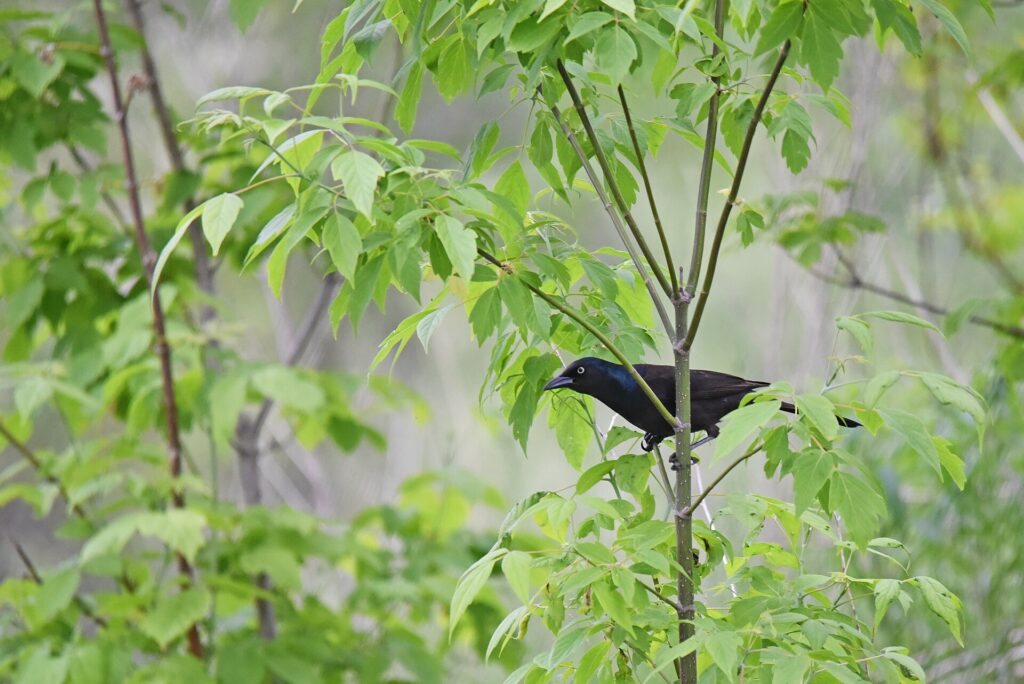
Step 3: Stop nesting before it starts
If grackles nest in your yard, you’ll have them from spring into summer. Common grackles usually nest high in conifers, and they sometimes nest in loose colonies of up to 200 pairs, according to Cornell. Great-tailed grackle nests can be more than 60 feet up in trees, or in marsh plants or on buildings where trees are scarce. Boat-tailed grackles mostly nest low in marsh grasses near the coast.
The Fish and Wildlife Service’s advice on problem nests comes down to timing: deal with a nest while it’s being built. A nest with no eggs or birds in it can be removed without a permit under federal law, but a nest with eggs or chicks is protected. The Service notes that state laws may be stricter, so check with your state wildlife agency. Its guidance also points to April through July as the season to watch.
- From April on, watch dense evergreens and trees near water, where Cornell says common grackles often nest.
- Pull down a nest under construction right away, while it’s still empty.
- If you find eggs or chicks, leave the nest alone. It won’t be long: Cornell lists an incubation period of 11 to 15 days and a nestling period of 10 to 17 days for the common grackle.
- Thinning dense trees and brush, which the Missouri extension guide recommends against roosts, also leaves fewer hidden nest sites.
What doesn’t work
- Fake owls, shiny tape and balloons. None of them removes the food or the roost trees, which are the reasons the flock is there.
- Scare devices on buildings. University of Missouri Extension says distress calls and scare devices are seldom successful at moving starling flocks off structures, and grackles mix into those same flocks.
- Taking the feeders down for a day. The pet food, trash, spilled seed and roost trees that drew the flock are still there the next morning. The food has to stay gone.
- Poison or shooting. Beyond the legal problem above, poison kills whatever eats it, including songbirds, pets and hawks.
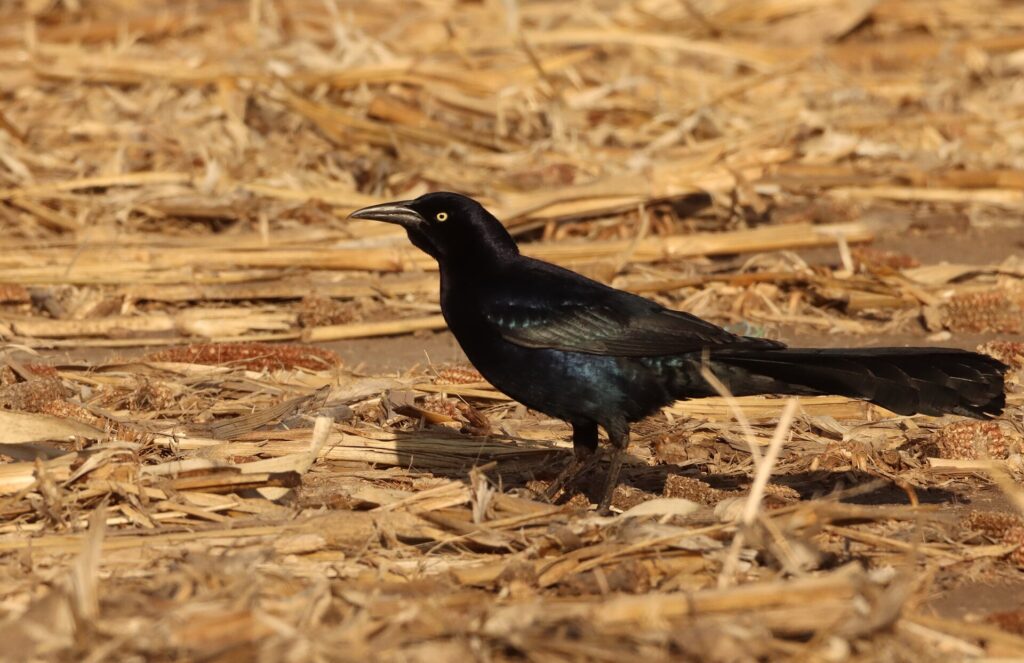
Will they leave on their own?
Often, yes. Grackle trouble is seasonal. Cornell notes that in winter common grackles forage and roost in large flocks with other blackbirds, and in spring they pair off to nest. Our piece on why grackles flock in fall explains the cycle. If the flock in your yard showed up in fall, cutting off the food and moving the roost gives it every reason to settle somewhere else.
The exception is a yard that keeps offering what they want. Grackles that can count on spilled seed, pet food and a dense row of evergreens have no reason to leave.
Common questions
Why are there suddenly so many grackles in my yard? A flock found food or a roost. Fall and winter flocks move around looking for both, and a yard with ground seed, open trash or dense trees gets noticed fast.
Do grackles hurt other birds? Sometimes. Cornell notes that common grackles raid nests and occasionally kill and eat adult birds. At feeders, the bigger problem is that a flock crowds smaller birds out.
Is it legal to kill grackles? Not for an ordinary backyard problem. Grackles are protected under the Migratory Bird Treaty Act, and the depredation order that allows control in damage situations requires nonlethal methods first, nontoxic shot, compliance with state law and annual reporting.
Can I remove a grackle nest? Yes, if it has no eggs or chicks and isn’t being used, according to the Fish and Wildlife Service. Once there are eggs or young in it, it stays until they’ve left. State law may be stricter.
Are grackles a problem everywhere? They’re common, but not as common as they were. Cornell reports common grackle numbers fell by nearly 2% a year from 1966 to 2019, a cumulative drop of about 54%, and lists it as a “Common Bird in Steep Decline.” Moving a flock along is fine. There’s no need to go further than that.
Bottom line
Grackles stay where food, shelter and nest sites are easy. Take the food away first: pet bowls, trash, fallen fruit, ground seed and cheap mixes. Move an evening roost with sharp noise, starting as the birds settle, for at least four evenings in a row, and thin out the dense trees they like. Pull down nests while they’re still being built, never once eggs are in them. Do those things and the flock has no reason to stay. For the feeder side of the problem in detail, head to our guide to stopping grackles and blackbirds at feeders.