Winter is the best feeder season in most of the country. Natural food is scarce, the leaves are down so you can actually see the birds, and the ones that stay are the reliable regulars: chickadees, juncos, cardinals, woodpeckers, nuthatches, finches. Which regulars you get depends on where you live, and that’s what this guide is for. Below are the birds most likely to show up at feeders from October through March in each part of the United States, drawn from Project FeederWatch, the Cornell Lab’s citizen-science count that tracks tens of thousands of backyards every winter. Then the short list of what to feed them.
The birds almost everyone gets
Six species turn up at the majority of winter feeders in nearly every region east of the Rockies, and most of them out west too. If you’re new to this, learn these first and you’ll know most of what lands.
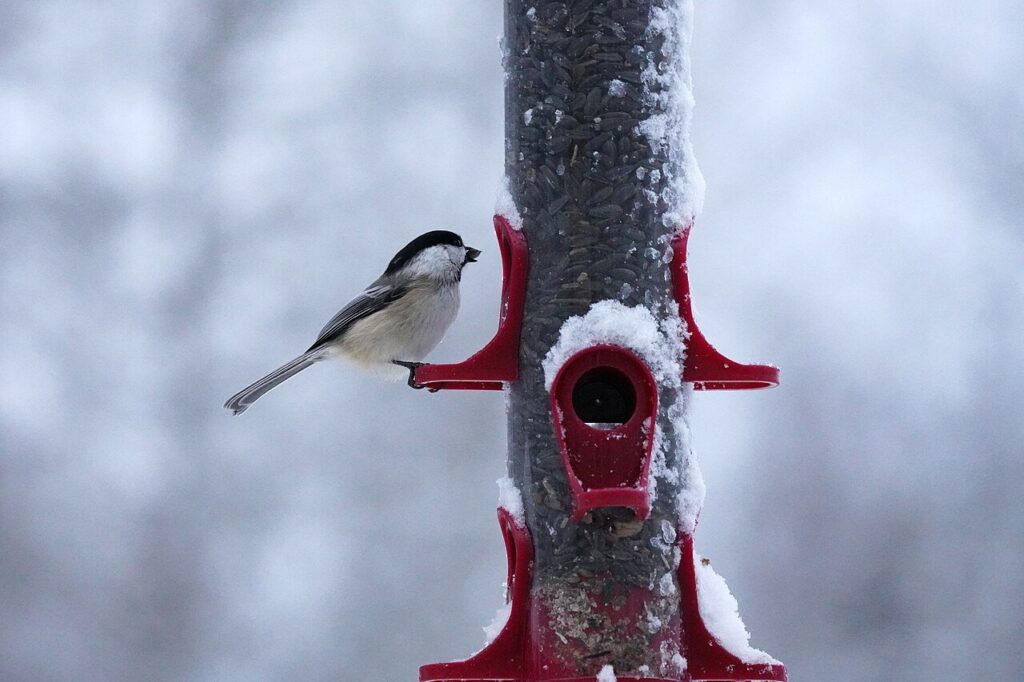
- Chickadee (black-capped in the north and west, Carolina in the south). The first bird at any new feeder, usually within a day. Grabs one seed and flies off to eat it.
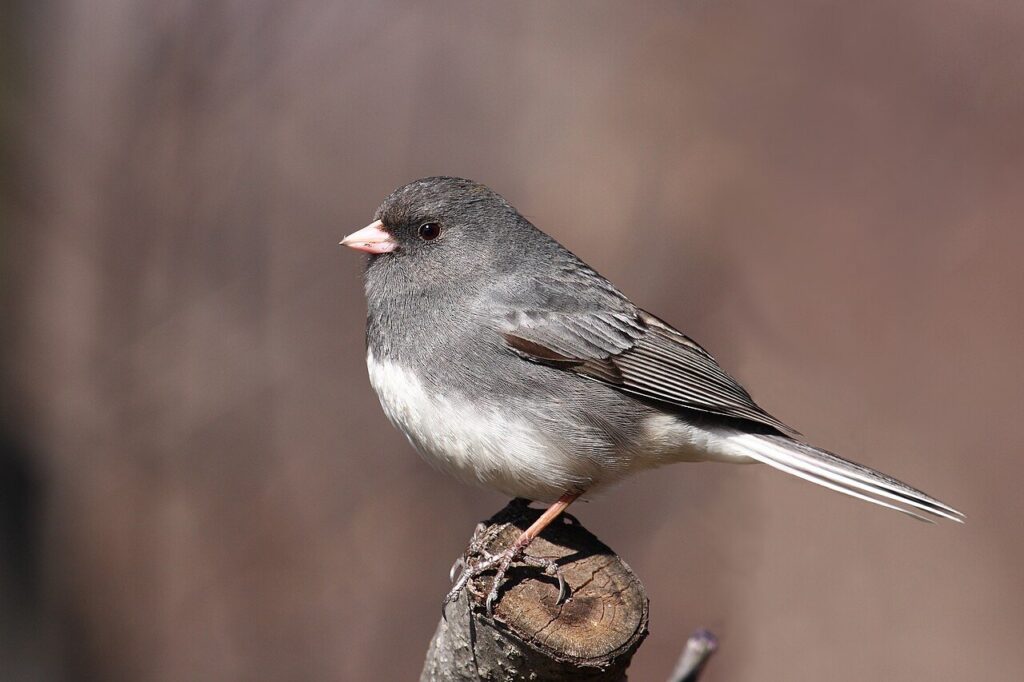
- Dark-eyed junco. The “snowbird.” Slate gray on top, white belly, white outer tail feathers that flash when it flies. Feeds on the ground under the feeder, not on it. Arrives with the first cold snap and leaves in April.
- Downy woodpecker. Sparrow-sized, black and white, red spot on the male’s head. Suet first, sunflower second.
- Northern cardinal. Not in the Northwest or most of the mountain West, but everywhere else it’s the bird people put feeders up for. Feeds at dawn and dusk; a tray or hopper suits it better than a tube.
- House finch. Streaky brown, the male with a raspberry-red head and chest. Comes in flocks and sits on the feeder for minutes at a time.
- Mourning dove. On the ground under the feeder, cleaning up what everyone else drops.
Northeast and Mid-Atlantic
Maine to Virginia, and west through Pennsylvania. This is the classic winter feeder picture: more than 90 percent of FeederWatch yards here report chickadees, juncos, downy woodpeckers, and cardinals, with blue jays, mourning doves, and goldfinches right behind. Goldfinches are here all winter but look nothing like their summer selves; the males molt to a dull olive-brown and people mistake them for a new species every December.
Watch for: white-breasted nuthatch (walks headfirst down the trunk), red-bellied woodpecker (the big one with the red cap and zebra back), tufted titmouse, white-throated sparrow under the feeder, and Carolina wren at the suet. In irruption years, when the seed crop fails up north, red-breasted nuthatches, purple finches, and pine siskins pour down and show up at feeders that never see them otherwise.
Midwest and Great Lakes
Ohio to the Dakotas, Minnesota down to Missouri. Same core cast as the Northeast, colder and with more woodpeckers: in Minnesota, 99 percent of yards report black-capped chickadees, 93 percent downy woodpeckers, and more than three-quarters get hairy and red-bellied woodpeckers too. Cardinals are common but thin out toward the northern edge. The Midwest specialty is the pileated woodpecker, crow-sized with a flaming red crest, which visits suet in more than half of Minnesota yards and startles everyone the first time.
Watch for: common redpolls in flocks at nyjer feeders in the coldest years (they came to 60 percent of Minnesota yards in the last irruption), purple finch, red-breasted nuthatch, and American tree sparrow on the ground. House sparrows and starlings are also more of a nuisance here than anywhere else; if they take over, switch to safflower for a few weeks.
In Minnesota? See our season-by-season guide to backyard birds in Minnesota, from winter redpolls to May orioles.
Southeast
Virginia to Georgia, west to Arkansas and east Texas. Milder winters mean fewer northern visitors and more of the year-round residents at the feeder. Georgia yards run about 97 percent cardinals, 94 percent Carolina chickadees, 93 percent Carolina wrens, and 92 percent tufted titmice, with house finches, downy and red-bellied woodpeckers, and mourning doves close behind. Two birds people up north would drive hours to see are ordinary here: the eastern bluebird, at three-quarters of Georgia feeders in winter (put out mealworms and they’ll stay), and the brown-headed nuthatch, a tiny squeaky pine-woods bird that loves suet.
Watch for: pine warbler and yellow-rumped warbler at suet (the only warblers that regularly use feeders), eastern towhee and chipping sparrow on the ground, brown thrasher, and northern mockingbird guarding the suet like it owns it. Juncos and white-throated sparrows still come this far south, but goldfinches show up in bigger flocks than they do in summer.
Florida and the Gulf Coast
Florida flips the script: winter isn’t the lean season, it’s the crowded one, because the state fills up with birds that spent the summer up north. Cardinals (93 percent of yards), mourning doves, blue jays, red-bellied woodpeckers, titmice, and mockingbirds anchor the feeder, and then the winter guests arrive: palm warblers bobbing their tails on the lawn, yellow-rumped warblers at the suet, gray catbirds in the shrubs, and Baltimore orioles at jelly and orange feeders from October to April (see our oriole feeder guide). Ruby-throated hummingbirds winter along the Gulf too, so leave one nectar feeder up.
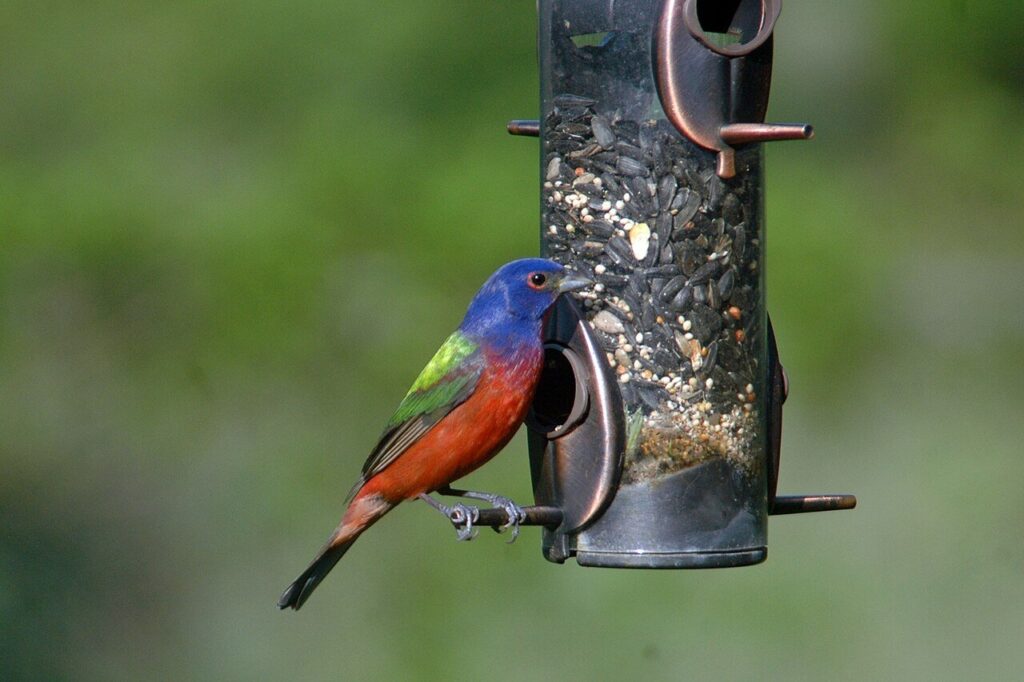
The Florida prize is the painted bunting, the most colorful songbird in North America, which winters in the peninsula and comes to white millet in a tube or tray feeder. More than a third of Florida FeederWatch yards get one. No juncos here, and chickadees drop out south of Orlando.
Texas and the Southern Plains
Texas is where east meets west. Cardinals (94 percent of yards) and Carolina chickadees lead as in the Southeast, but the third most common feeder bird is the white-winged dove, a big pale dove with a white wing stripe that has spread across the state and can empty a tray feeder in an afternoon. House finches, blue jays, Carolina wrens, goldfinches, and mockingbirds fill out the top ten. Juncos reach north and central Texas but not the coast.
Watch for: ruby-crowned kinglet at suet, yellow-rumped warbler, chipping sparrow flocks, and along the coast the same painted buntings Florida gets. In the Hill Country and west, black-crested titmouse and lesser goldfinch replace their eastern cousins.
Mountain West and Southwest
Colorado, Utah, New Mexico, Arizona, and inland California. The house finch is king here, at 90 percent of Southwest yards, and juncos are nearly as common, but they’re different juncos: the “Oregon” form with a black hood and brown back, and in the mountains the pink-sided and gray-headed forms. Cardinals are absent except in southern Arizona. In their place come Eurasian collared-doves, northern flickers (the West’s most common feeder woodpecker), spotted towhees scratching under the feeder, lesser goldfinches, and flocks of pine siskins.
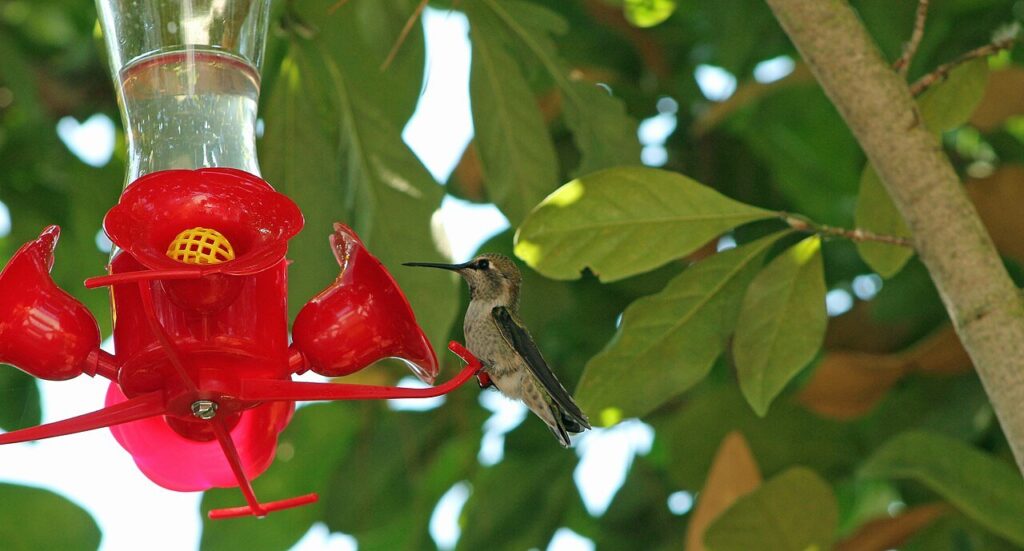
Watch for: black-billed magpie and mountain chickadee in Colorado, white-crowned sparrow everywhere, bushtits mobbing the suet in a flock of twenty, and Anna’s hummingbird, which stays all winter across the Southwest and coastal California and will use a nectar feeder in January. In Colorado, keep a heated bath going; it draws more birds than the seed does when everything else is frozen.
Pacific Northwest and Northern California
Washington, Oregon, and the coast down through the Bay Area. Wet, mild winters and a completely different cast from the East. Juncos are at 98 percent of Washington yards, then black-capped and chestnut-backed chickadees, spotted towhees, flickers, and Anna’s hummingbirds, which visit nearly 80 percent of Washington feeders in the middle of winter. Song sparrows, pine siskins, red-breasted nuthatches, and Steller’s jays (the crested, dark blue western jay) round out the top ten.
Watch for: varied thrush, an orange-and-slate robin cousin that comes down out of the hills to feed on the ground under feeders in cold snaps; golden-crowned and white-crowned sparrows; bushtits; and Townsend’s warbler at suet. No cardinals, no blue jays, no titmice. To sort out the brown sparrows under your feeder, see our guide to common winter sparrows. More orange-bellied lookalikes of the varied thrush are in our gray bird with an orange belly guide.
What to feed them: four things, no more
Winter feeding is simpler than the seed aisle makes it look. Every bird in every region above is covered by four items.
Black-oil sunflower seed
The one seed that feeds everything: chickadees, cardinals, finches, nuthatches, titmice, jays, woodpeckers, grosbeaks. Thin shell, high fat. Buy it by the 20- or 25-pound bag, because you’ll go through it, and store it in a metal can with a lid so mice don’t. Wagner’s 25-pound black-oil sunflower is the standard. Skip the “wild bird mix” bags with red milo, wheat, and cracked corn; most feeder birds kick that filler onto the ground, where it rots.
Suet
Rendered beef fat in a cake, and the single best thing you can add in winter. It brings every woodpecker, both nuthatches, chickadees, titmice, wrens, and in the South and West the warblers and kinglets that never touch seed. Wildlife Sciences High Energy suet, 10-pack is a reliable choice: it fits every standard cage. Hang it in a cage feeder with a tail prop if you want the big woodpeckers; the iBorn metal tail-prop suet feeder gives a red-bellied or pileated somewhere to brace, and they stay longer.
Nyjer (thistle) for the finches
Only if you want goldfinches, siskins, and redpolls in numbers. They’ll eat sunflower too, but a nyjer sock or mesh tube fills up with twenty of them at a time and nothing else bothers it. Buy small bags; nyjer goes stale in a couple of months and the birds ignore it once it does.
Water
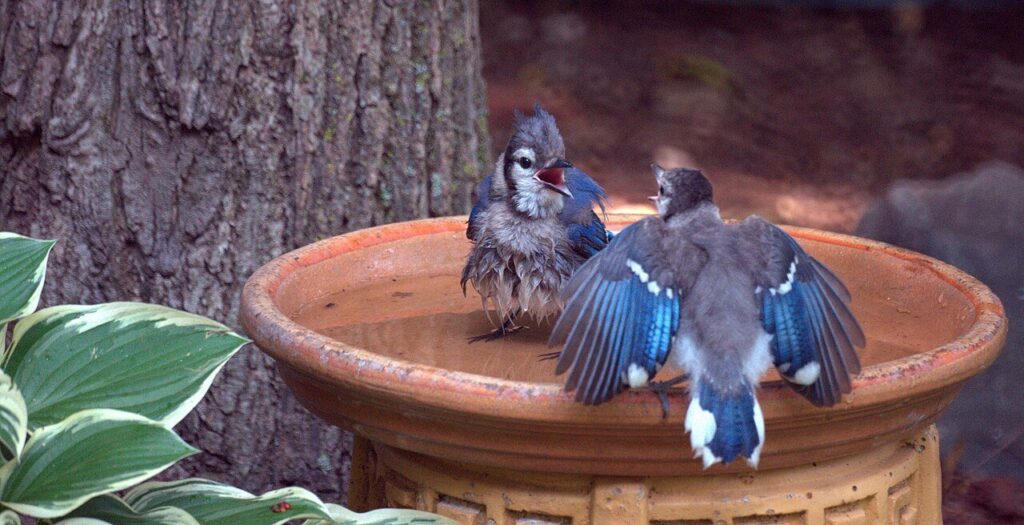
North of the frost line, open water in January pulls in birds that never come to seed: robins, bluebirds, waxwings, and the whole feeder crowd besides. A heated bird bath is the cheapest way to double the species count in a northern yard. In the South, a plain bath kept clean does the same job; see our bird bath guide.
For the full list, including which foods are worth the money and which ones birds leave behind, see our guide to what to feed birds in winter.
Quick reference by region
| Region | Most common at feeders | Regional specialty | Best add-on |
|---|---|---|---|
| Northeast | Chickadee, junco, downy, cardinal, blue jay | Irruption finches (siskin, purple finch, redpoll) | Suet, heated bath |
| Midwest | Chickadee, junco, downy, blue jay, nuthatch | Pileated woodpecker, common redpoll | Suet with tail prop |
| Southeast | Cardinal, Carolina chickadee, Carolina wren, titmouse | Eastern bluebird, brown-headed nuthatch | Mealworms |
| Florida / Gulf | Cardinal, dove, blue jay, red-bellied, mockingbird | Painted bunting, Baltimore oriole, warblers | White millet, jelly, nectar |
| Texas / Plains | Cardinal, Carolina chickadee, house finch, white-winged dove | White-winged dove, kinglet | Safflower (doves hog sunflower) |
| Mountain West / SW | House finch, junco, collared-dove, flicker | Magpie, mountain chickadee, Anna’s hummingbird | Heated bath, nectar |
| Pacific NW | Junco, chickadees, towhee, flicker, Anna’s | Varied thrush, Steller’s jay, bushtit | Suet, nectar |
Three winter rules
Keep it up. Birds don’t become dependent on feeders, but once a flock has learned your yard, a feeder that goes empty during a cold snap is a wasted opportunity. Fill it before storms, not after.
Keep it clean. Wet seed molds, and crowded feeders spread disease, especially among finches. Scrub feeders every two weeks with hot soapy water, rake up the shells under them, and if you see a finch with crusty eyes, take the feeders down for a week.
Give them cover. A feeder in the open gets picked over by Cooper’s hawks (a third of Southwest yards report one). A brush pile or evergreen within ten feet gives the small birds somewhere to dive. It also gives you more birds, because they’ll stage in the cover and come out one at a time. If the yard is new to feeding, start with the basics, and put the first feeder on the window where you’ll actually watch it.
Skip the bread and the bargain mix. Bread fills a bird up with nothing it can use, and the cheap “wild bird” bags are mostly milo and cracked corn that sunflower-eaters kick to the ground, where it rots. Salted nuts, anything moldy, and dry uncooked rice are also off the list. If you want a fifth food, stick to unsalted peanuts or dried mealworms for the bluebirds and wrens.
Leave the fruit on the tree. An old apple or crabapple you never got around to picking is one of the best winter feeders you own. Robins, cedar waxwings, mockingbirds, and bluebirds will strip frozen fruit in January when the insects are gone, and the birds that flock to a fruiting tree are exactly the ones that ignore seed feeders. Holly, dogwood, sumac, and hackberry do the same job. If you are planting anything this fall, plant one of those.
Related: The best suet feeders · Keeping water open in winter · Keeping squirrels off feeders · The best window bird feeders
For the feeder side of winter, see what to feed birds in winter, the best feeders for cardinals, and, if a blackbird flock has moved in, why grackles flock in fall and how long they stay.