Most ruby-throated hummingbirds leave Connecticut between late August and the end of September. Adult males slip out first, often in August, while females and the year’s young keep visiting feeders through September. A few stragglers linger into the first or second week of October, and Connecticut Audubon notes that its latest fall sighting in Southport was October 7. Keep your feeder up until at least two weeks after your last visitor, and expect the first birds back in late April.
Which hummingbirds live in Connecticut?
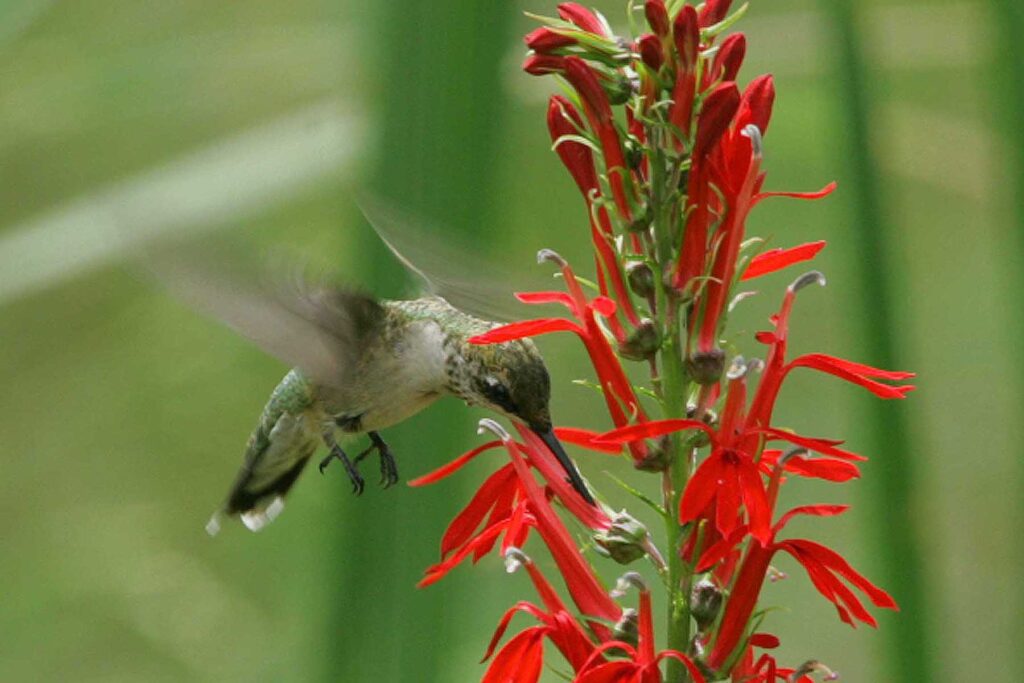
Connecticut has one regular hummingbird: the ruby-throated hummingbird. The Cornell Lab of Ornithology describes it as eastern North America’s only breeding hummingbird, and Connecticut Audubon calls it almost exclusively the only hummingbird you’ll meet here in summer. If you see a hummingbird in a Connecticut yard between May and September, it’s a ruby-throat.
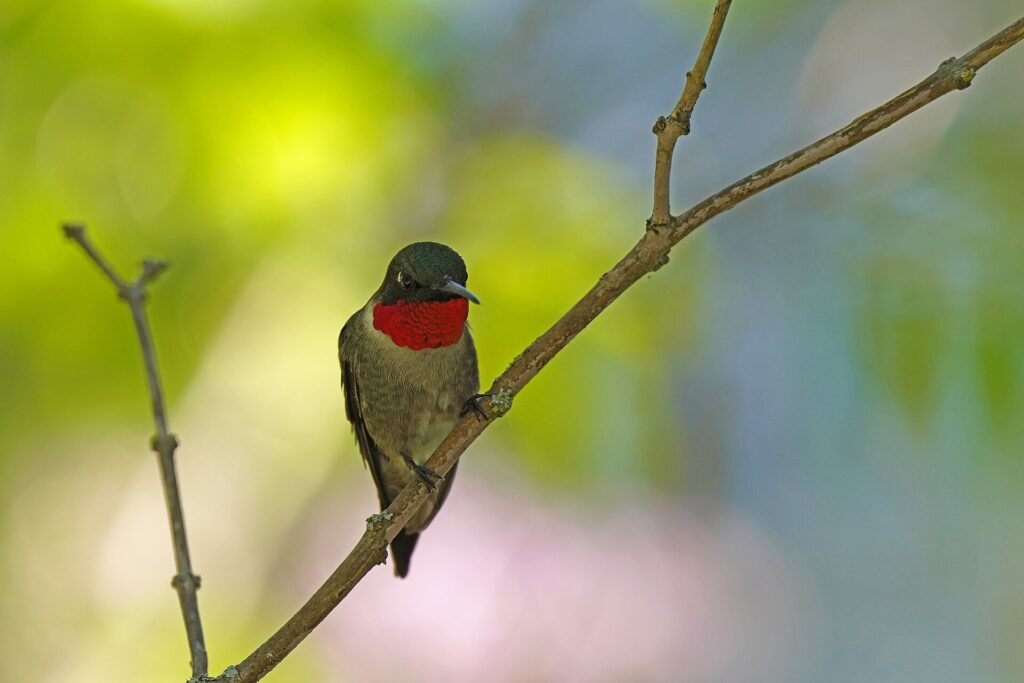
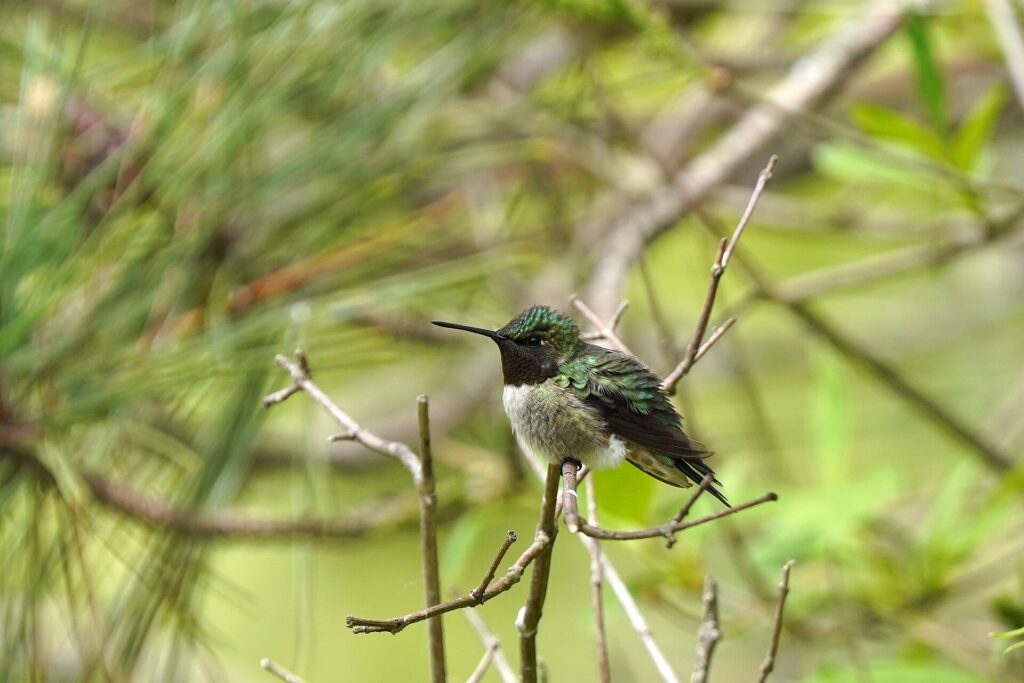
Males are iridescent green above with a throat patch that flashes red in good light. Females and juveniles are green above, pale below, and show white tips on the outer tail feathers. Females are also a touch larger. The birds you see in September are mostly females and young, so red throats vanish weeks before the last bird leaves.
When do hummingbirds leave Connecticut in the fall?
Fall departure is a slow drain, not a single day. According to Cornell, males can begin migrating as early as August, since they have no role in raising the young. In Connecticut that means adult males start thinning out in the second half of August, and by Labor Day many yards have none left.
Females and juveniles follow through September. This is often the busiest month at feeders, because birds from farther north are passing through the state at the same time local families are fattening up. Connecticut Audubon puts the main departure around the end of September, with the birds heading to wintering grounds mostly in Central America.
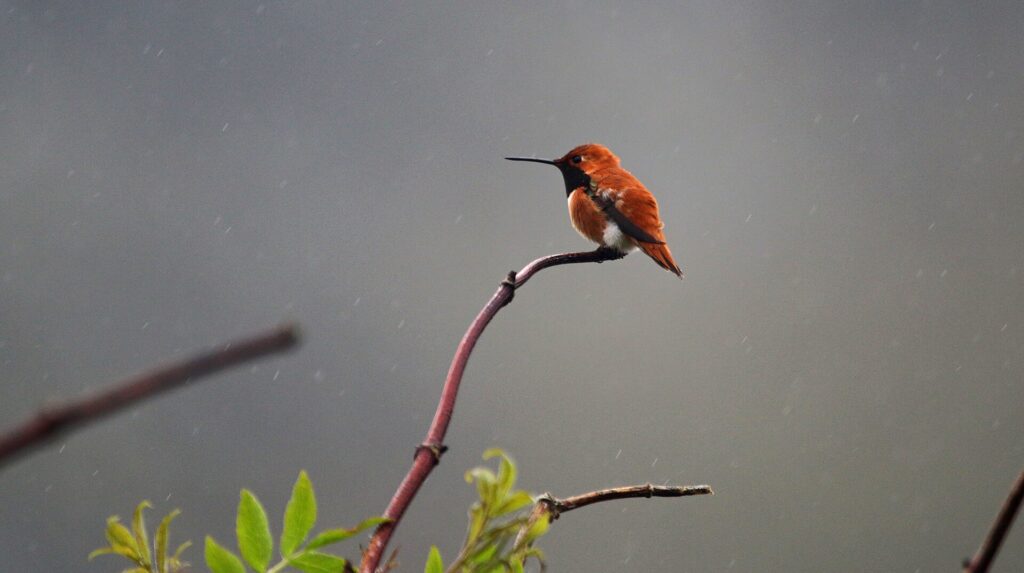
Then come the stragglers. Sightings in the first week of October are normal, and Connecticut Audubon’s October 7 record shows ruby-throats can hang on into the second week. After mid-October, the same source says any hummingbird in Connecticut is very likely a western species such as a rufous hummingbird. eBird and Journey North both show late-season Connecticut reports by town.
Curious how Connecticut compares to the rest of the country? Our 50-state hummingbird departure table lays it out.
Connecticut hummingbird calendar, month by month
| Month | What’s happening in Connecticut | What to do |
|---|---|---|
| April | First males arrive, usually the last two weeks. Journey North logged a first sighting in Oxford on April 15, 2026, and April 17 the year before. | Hang feeders by April 15. Fresh nectar, no dye. |
| May | Females arrive and main arrival wraps up. Courtship and nest building begin. | Keep feeders full. Plant natives for summer bloom. |
| June | Nesting. Females may be scarce at feeders while incubating. | Change nectar every 2 to 3 days as it warms. |
| July | Young leave the nest. Feeder traffic climbs. | Change nectar daily or every other day in heat. |
| August | Adult males begin leaving. Birds bulk up on nectar and insects. | Keep feeders clean and full. Do not take them down. |
| September | Peak fall movement. Females, juveniles, and northern migrants pass through. Most gone by month’s end. | Keep feeders up all month. |
| October | Stragglers in the first two weeks. After mid-month, any hummingbird deserves a close look. | Leave feeders up 2 weeks past your last sighting, longer if you can. |
Why do hummingbirds leave? It’s not your feeder
A common worry is that a full feeder will tempt a hummingbird to stay too long and get caught by frost. It won’t. Cornell states plainly that keeping feeders up “has no influence on whether a bird will start its journey south.” Audubon says the same: ruby-throats are genetically programmed to head south, cued by shortening days and the changing angle of the sun, not by food.
In fact, the opposite is true. Before migration a ruby-throat can nearly double its weight in about a week, according to Journey North, going from roughly 3.25 grams to over 6 grams. That fat fuels flights of nearly 600 miles nonstop for birds that cross the Gulf of Mexico. A reliable feeder in a Connecticut yard in September is a fuel stop, not a trap.
Late birds are usually young of the year or northern migrants that got a slow start, and they need calories most. That’s the argument for leaving your feeder up after the crowd has gone.
When should you take down hummingbird feeders in Connecticut?
The simple rule: wait two weeks after the last hummingbird you see, then take it down. For most Connecticut yards that lands somewhere between mid-October and the end of October. Cornell recommends leaving feeders up several weeks after your last bird in case stragglers arrive needing energy.
There’s a second reason to stretch it further. Since the 1980s, western hummingbirds have shown up in the East in growing numbers each fall. eBird reports that from October through January the rufous hummingbird is by far the most common hummingbird in the East, with females and immatures arriving from mid-October and peaking between mid-October and late November. Connecticut Audubon’s advice is direct: any hummingbird at your feeder after October 1 “should be thoroughly scrutinized.” Connecticut also has four accepted calliope hummingbird records and one broad-billed hummingbird, per eBird.
If you want a shot at a rarity, eBird suggests keeping a feeder out through mid-December, hanging it near evergreen cover, and bringing it inside on freezing nights so the nectar doesn’t ice up. Audubon notes that late migrants or out-of-range species can turn up into early winter. If you see a hummingbird in Connecticut in November, photograph it and report it to eBird.
For a fuller breakdown of timing, cleaning, and storage, see our guide on when to take down hummingbird feeders.
When do hummingbirds return to Connecticut in the spring?
Ruby-throats come back to Connecticut in late April, with the first males typically reported in the second half of the month and most yards seeing birds by early May. Connecticut Audubon describes them as absent until late April. Journey North’s community sighting reports back that up: an Oxford observer logged a first bird on April 15, 2026, earlier than her April 21 sighting the previous year, and Connecticut’s earliest 2025 report came on April 17.
Males arrive first in spring, too. Journey North notes that males leave the Yucatan roughly 10 days ahead of females. Connecticut Audubon’s tip is to watch the migration maps and hang your feeder as soon as birds are reported in New Jersey, because Connecticut is a few days behind.
A safe target is to have nectar out by April 15. An early bird that finds nothing may keep moving.
Nectar recipe and feeder cleaning for Connecticut summers
Both Cornell and Audubon give the same recipe: one part plain white table sugar to four parts water, or a quarter cup of sugar per cup of water. Stir until dissolved. Skip red dye entirely. Natural nectar is clear, the red parts of the feeder do the attracting, and coloring adds nothing the birds need. Don’t use honey, brown sugar, or artificial sweeteners.
Cleaning frequency depends on heat. Cornell warns that sugar water ferments quickly in hot weather and produces alcohol that’s toxic to hummingbirds. Audubon’s schedule:
- Hot weather (July and August heat waves in Connecticut): change nectar daily or every other day.
- Mild weather (May, June, September): every three days.
- Cool weather (late April, October): twice a week.
- Any time the nectar looks cloudy or you see black specks: dump it and scrub.
Clean with hot water and a bottle brush, using a weak vinegar solution or a splash of hydrogen peroxide for mold. Rinse well and skip dish soap, which leaves residue. Our feeder cleaning guide covers the full routine, and if you’re shopping for one that comes apart easily, see our hummingbird feeder guide.
Where to see hummingbirds in Connecticut, and what to plant for fall
The best hummingbird spot in Connecticut is a yard with red, tubular native flowers, and Connecticut Audubon says to look around flower gardens for exactly that. Ruby-throats use semi-open habitat: woodland edges, clearings, gardens, and parks. Connecticut Audubon runs nature centers and sanctuaries around the state, including the Coastal Center at Milford Point and Deer Pond Farm in Sherman, that host bird programs and pollinator gardens worth a visit in summer.
To hold birds through September, plant natives that bloom late. Audubon Connecticut’s native plant list for hummingbirds includes:
- Cardinal flower (Lobelia cardinalis) and great blue lobelia, for wet, sunny spots. Cardinal flower is the classic late-summer hummingbird plant.
- Jewelweed (Impatiens capensis), a Connecticut native that the Federated Garden Clubs of Connecticut note blooms just ahead of fall migration.
- Trumpet honeysuckle (Lonicera sempervirens), a native vine that blooms into fall.
- Bee balm and wild bergamot (Monarda), for midsummer.
- Garden phlox, beardtongue, and columbine to cover spring and early summer.
Skip pesticides. Audubon points out that spiders and insects make up a large share of an adult hummingbird’s diet, and native plants support far more of them. Leave a few bare twigs on shrubs for perches, and consider a mister, which Audubon calls an especially attractive water source for hummingbirds. Our bird-friendly garden guide has more on planning a yard that works all season.
Frequently asked questions
Is it too late to put up a hummingbird feeder in Connecticut in September?
No. September is peak fall movement in Connecticut, with local birds and northern migrants both passing through. A fresh feeder in early September can be busier than one in June.
I saw a hummingbird in Connecticut in November. What is it?
Probably not a ruby-throat. After mid-October, Connecticut Audubon says a hummingbird here is very likely a western species, most often a rufous hummingbird. Get photos, note the tail and flank color, and report it to eBird so it can be documented.
Do hummingbirds in Connecticut fly across the Gulf of Mexico?
Some do. Audubon notes that many ruby-throats follow the Texas coast around the Gulf, while others cross it directly, a flight Meigs Point Nature Center in Madison describes as about 500 miles over 18 to 20 hours. Either way, they winter from Mexico south to Costa Rica and Panama.
Bottom line
Ruby-throated hummingbirds leave Connecticut from late August through September, with a few hanging on into early October. Day length drives their departure, so your feeder can’t hold them back; it only helps them fuel up. Leave it up at least two weeks past your last sighting, into November if you’d like a chance at a rare western visitor, and have it back out by mid-April for the first males returning in late April.